

Home / Blog Posts / The Difference Between Kilowatts and Kilovolt Amperes
07 Apr, 2026
Posted by Mega Solution Electrical Engineering Ltd
0 comment
The Difference Between Kilowatts and Kilovolt Amperes
Kilowatts and Kilovolt Amperes: If you’ve ever looked at an electricity bill, inspected a generator spec sheet, or sized a transformer for a new building, you’ve probably seen the acronyms kW and kVA side‑by‑side. At first glance they seem interchangeable, both are “kilowatt‑something” and both describe power.
Yet they tell you very different stories about how electricity is used, how much equipment you need, and how much you’ll pay. In this post we’ll unpack the kilowatt (kW) and kilovolt‑ampere (kVA), explain the physics that separates them, show how the power factor ties them together, and illustrate why mastering this distinction can save you money, improve reliability, and extend the life of your assets.
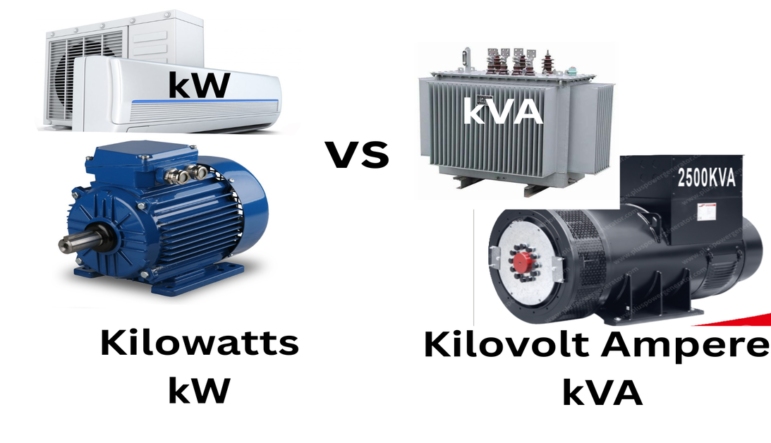
Kilowatts (kW) Vs Kilovolt Amperes (kVA)
The Difference Between Kilowatts (kW) and Kilovolt Amperes (kVA): Understanding Electrical Power Measurement
When it comes to measuring electrical power, two units are commonly used: kilowatts (kW) and kilovolt amperes (kVA). While they are related, these units serve distinct purposes and are crucial for professionals in various fields, including electrical engineering, construction, and energy management. In this blog post, we’ll explore the differences between kilowatts and kilovolt amperes, and why understanding their distinction is essential for effective energy management.
Kilowatts (kW): Measuring Real Power
Kilowatts represent the actual or real power used by electrical equipment to perform useful work. This includes energy consumption by motors, lighting, and other devices. Kilowatts take into account the efficiency of the equipment and real-world factors, measuring the power that is converted into usable energy. In essence, when you pay your electricity bill, you’re typically charged for the kilowatts of energy consumed.
Real Power (kW) – The Work‑Doing Energy
| Aspect | What it means | Real‑world examples |
|---|---|---|
| Definition | The actual or real power that is converted into useful work. | Motors turning a conveyor, LED lights illuminating a hallway, a computer’s processor running calculations. |
| What it measures | Energy that leaves the source and ends up as heat, motion, light, sound, etc. | The kilowatt‑hours (kWh) you’re billed for. |
| Influencing factors | Equipment efficiency, load profile, temperature, friction, etc. | A 10 kW motor that’s only 80 % efficient will draw more apparent power than the 10 kW it delivers. |
| Billing | Utilities charge you for kWh—the cumulative kilowatts consumed over time. | Your monthly electricity bill. |
Bottom line: kW tells you how much useful power is actually being consumed.
Kilovolt Amperes (kVA): Measuring Apparent Power
On the other hand, kilovolt amperes provide a measure of apparent power, which is a combination of both real power and reactive power. Reactive power is the power that oscillates between the source and the load, and it doesn’t contribute to the actual work being done. Think of it as the power needed to establish electric and magnetic fields in devices like transformers and motors. In simple terms, kVA is the total power flowing through the system, while kW is the power that performs work.
Apparent Power (kVA) – The Total Power Flow
| Aspect | What it means | Real‑world examples |
|---|---|---|
| Definition | The combined magnitude of real power and reactive power that flows through a circuit. | The total current required to energize a transformer’s magnetic field, even though that energy isn’t doing “useful” work. |
| What it measures | The vector sum of real power (kW) and reactive power (kVAR). | The rating on a generator plate—e.g., “150 kVA”. |
| Reactive power | Power that oscillates between source and load, creating electric‑magnetic fields but not delivering net energy. | Inductive loads (induction motors, fluorescent ballasts) and capacitive loads (power factor correction banks). |
| Billing | Some commercial tariffs add a demand charge based on kVA or kVAR, especially where the utility must accommodate large reactive currents. | Industrial electricity contracts. |
Bottom line: kVA tells you how much total current the system must carry, regardless of whether that current produces work.
The Power Factor is what Bridges the Gap Between Kilowatts (kW) and Kilovolt Amperes (kVA)
The relationship between kW and kVA can be expressed through the power factor, a dimensionless number between 0 and 1 that indicates the efficiency of power usage. The formula to convert kVA to kW is straightforward: kW equals kVA multiplied by the power factor. For example, if you have a system operating at 100 kVA with a power factor of 0.8, the real power output in kilowatts would be 80 kW.
Quick Example of Kilowatts and Kilovolt Amperes
System rating: 100 kVA
Power factor: 0.8 (typical for many industrial motor loads)
kW = 100\kVA times 0.8 = 80kW
The system supplies 80 kW of real power while the remaining 20 kVA represents reactive power that only circulates between the source and the load.
Practical Applications: Why Understanding Kilowatts and Kilovolt Amperes Matters
Understanding the difference between kW and kVA is crucial for accurately sizing generators, transformers, and other electrical equipment. In practical applications, knowing the distinction between these units helps engineers design systems that maximize efficiency and reduce costs. When selecting generators, for instance, understanding the load’s power factor and the necessary kW and kVA ratings ensures that the equipment can handle the demand. Failure to consider these aspects can lead to oversizing or under-sizing, potentially resulting in higher operational costs and reduced equipment lifespan
Generator Sizing
| Scenario | Mistake | Consequence |
|---|---|---|
| Undersizing (selecting only based on kW) | Ignoring reactive demand (low PF) | Generator overloads during start‑up, trips, reduced lifespan. |
| Oversizing (selecting based on kVA alone) | Paying for excess capacity you never use | Higher capital cost, lower fuel efficiency, larger footprint. |
| Correct approach | Calculate both kW and kVA using the expected PF | Right‑sized generator → optimal fuel use, lower O&M cost. |
Transformer Selection
Transformers are rated in kVA because they must handle the total current, not just the real component. Choosing a transformer based solely on kW can lead to overheating and premature failure.
Electrical System Design
- Cable sizing: Conductors are sized for the current (derived from kVA), not just real power.
- Protective devices (breakers, fuses) must accommodate the apparent current.
- Power factor correction: Installing capacitor banks can boost PF, reducing kVA demand, shrinking equipment size, and lowering utility demand charges.
Cost Management
- Energy charges → based on kWh (real power).
- Demand charges → often based on kVA or peak kW.
- Penalty fees → many utilities impose extra fees for PF < 0.9.
Improving PF can therefore translate directly into dollar savings.
Real‑World Checklist for Engineers & Facility Managers when it comes to Kilowatts and Kilovolt Amperes
| ✅ | Action Item | Why It Matters |
|---|---|---|
| 1 | Measure the actual load (kW) using power meters. | Establish baseline real power consumption. |
| 2 | Determine the power factor of each major load (motors, HVAC, lighting). | Identify where reactive power is high. |
| 3 | Calculate apparent power (kVA = kW / PF). | Size generators, transformers, cables correctly. |
| 4 | Assess utility tariff structure (energy vs. demand vs. PF penalties). | Prioritize actions that give the highest ROI. |
| 5 | Implement PF correction where PF < 0.95 (capacitor banks, synchronous condensers). | Reduce kVA demand and associated costs. |
| 6 | Re‑evaluate after changes (new equipment, expansions). | Keep equipment sizing and cost models up‑to‑date. |
Frequently Asked Questions about Kilowatts (kW) and Kilovolt Amperes (kVA)
| Question | Short Answer |
|---|---|
| Do I need both kW and kVA ratings on a generator? | Yes. kW tells you the usable output; kVA tells you the total current the generator must handle. |
| Can I improve my PF by simply buying a “high‑efficiency” motor? | Partially. High‑efficiency motors often have better PF, but adding dedicated PF correction devices yields larger gains. |
| Is reactive power “wasted”? | Not exactly. It’s necessary for magnetic fields in inductive equipment, but it does not produce useful work, so we try to minimize excess reactive flow. |
| Why do utilities care about PF? | Low PF means higher currents for the same real power, leading to greater losses in the distribution network. |
Bottom Line
- Kilowatts (kW) = real power → the energy that actually does work and shows up on your electricity bill.
- Kilovolt‑amperes (kVA) = apparent power → the total power the system must carry, including both real and reactive components.
- Power factor (PF) bridges the two: kW = kVA × PF.
Understanding and applying these concepts enables you to:
- Select the right size of generators, transformers, and conductors.
- Avoid costly over‑ or under‑specification.
- Reduce operating expenses through PF improvement and accurate demand management.
- Extend equipment life by keeping currents within design limits.
When you look at a spec sheet or a utility bill, ask yourself: Am I seeing the real work being done (kW) or the total power flowing through the system (kVA)? The answer will guide smarter design, better budgeting, and greener, more efficient energy use.
Conclusion
In conclusion, while kilowatts and kilovolt amperes are closely related concepts in electrical engineering, they measure different aspects of electrical power. Kilowatts reflect the actual power consumed for work, while kVA account for both real and reactive power. By understanding these differences and how to calculate them using the power factor, professionals can ensure effective energy management and optimize performance in their systems. Whether you’re an electrical engineer, a construction professional, or an energy manager, grasping the distinction between kW and kVA is essential for making informed decisions and achieving efficiency in your work.
 Posted on Google
 Amos Appiah
Trustindex verifies that the original source of the review is Google.
Thank you Mega Solution Electrical Engineering for your prompt and Professional Electrical Service in Tema Sakumono( C.O.P Sophia Cudjoe Temple) We will always get in touch for further contracts. Good Job!Posted on Google Emmanuel WilsonI hired a licensed electrician from mega solution electrical in Kumasi, the service was done professionally and met all standards. It gave me peace of mind. I will recommend them to every bodyPosted on Google
 Denzel MintahThey’re the best and most reliable electrical company in Ghana I’ll always recommend them to everyonePosted on Google
 Jessica NgThanks for solving our electrical problem so fast, coming all the way to Cantonments.Posted on Google
 Charles Adom-OpokuMega Solution demonstrates exceptional expertise in genset systems. Their professionalism, technical proficiency, and industry experience set them apart. I highly recommend their services to anyone seeking reliable and knowledgeable partners in this field.Posted on Google
 Giuseppe M_CThis best experience I had in a while, Richard provided all the help I was looking for. Thank you, this is a 10 Stars service!Posted on Google
 Joseph OtooBest electrical company in GhanaPosted on Google
 Junior JesusBest Electrician in Ghana | best electrical engineer at good location | over 30 years experience | good electrical service. Thank you so much. I’m very happy
When searching for a reliable electrician, call us at +233 24 415 1232 We specialize in electrical repairs, indoor and outdoor lighting installations, panel upgrades, and even hot tub wiring!
Always Hire Professional Electrical Energy and Power Auditors
No matter urgent any electrical repairs seem, it’s never okay to attempt to handle them on your own. Trying to take care of electrical problems without professional training is extremely dangerous. If you or someone else aren’t hurt during your attempt, there’s still a chance that you’ve left something undone that poses a huge risk to you, your home, or your family. Visit Our Google Business Profile
Electrical Power and Wiring Audit in Accra – Ghana
mega solution electrical Power and wiring audit in Accra, Ghana knows what a hassle any electrical problems can be, which is why we’ll always respond to any requests for service as quickly as possible. And because all of our technicians are licensed, background checked, and professionally trained, you’re guaranteed to receive the best quality service and workmanship available when you call us. We can assist with all your electric needs including:
- Generator Installation and Repair Services
- Best Industrial Electrical Automation services
- Best Electric Motor Rewinding Services
- Earthing Installations and Upgrades Services
- Electro-Mechanical services
- Lighting Installation
- Residential Electrical Installation Services
- Electrical Panel Replacement
- LED Lighting
- Industrial electrical Installation Services
- Electrical Troubleshooting and Repairs
- Professional Electrical Support and Training Services
- Electrical Wiring Design and Engineering Services
- Electrical Energy and Power Auditing Services
- Distribution Panels Fabrication and Upgrades Services
- Professional electrical contractors in Ghana
- Commercial electrical Installation Services
- Licensed Electricians in Ghana
- Home Wiring
- Consulting and Advisory services
- Electrical Wirings Testing and Inspection Services
- Wiring Replacement and Upgrade Services
- Residencial, commercial and Industrial wiring Services

Mega Solution Electrical Engineering Ltd
Mega Solution Electrical Engineering Ltd, a licensed and certified electrical engineering company in Ghana specializing in electrical contracting, generator maintenance, energy audits, and industrial electrical services.
Search
Electrical Wiring Contract – What Can Go Wrong or Right
Generator Service Experts in Ghana, When the Lights Go Out – Mega Solution Electrical to the Rescue!
Categories
- Certified Electricians Ghana
- Earthing Installations
- Earthing Maintenance
- Electrical Consulting
- Electrical Contractors
- Electrical Installation Ghana
- Electrical Maintenance Ghana
- Electrical Repair Ghana
- Electrical Safety
- Electrical Training
- Energy Auditing
- Engineering Services
- Generator Installation
- Generator Maintenance Ghana
- Generator Repair
- Generator Services
- Generator Servicing Ghana
- Ghana Electrical Licensing
- Ghana Electrical Services
- Installation Services
- Licensed Electricians
- Motor Rewinding
- Residential Electrical Service
Archive
| M | T | W | T | F | S | S |
|---|---|---|---|---|---|---|
| 1 | 2 | 3 | 4 | 5 | 6 | |
| 7 | 8 | 9 | 10 | 11 | 12 | 13 |
| 14 | 15 | 16 | 17 | 18 | 19 | 20 |
| 21 | 22 | 23 | 24 | 25 | 26 | 27 |
| 28 | 29 | 30 | ||||
Tags
- Agricultural Engineering
- Cable Sizing
- Commercial Electrical Contracting
- Earthing Installations and Upgrades Services
- Earthing Systems
- Earthing System Upgrades
- Electrical Advisory Service
- Electrical Company
- Electrical Contractors in Ghana
- Electrical Design Ghana
- Electrical Energy and Power Auditing Services
- Electrical Energy Auditing
- Electrical Load Calculation
- Electrical Panel Upgrades
- Electrical Repair Services
- Electrical Safety Training Ghana
- Electrical Services Ghana
- Electrical Training Services Ghana
- Electrical Troubleshooting
- Electrical Wiring Certificate Ghana
- Electrical Wiring Design and Engineering Services
- Electrical Wiring Design Ghana
- Electrical Wiring Installation
- Electrical Wiring Upgrades
- Electrical Workshop Training
- Electricians
- Electricians in Ghana
- Engineering Services Ghana
- Generator experts in Ghana
- Generator Installation and Repair Services
- Generator Maintenance Contracts
- Generator Maintenance Ghana
- Generator Repair Services
- Industrial Electrical Wiring
- Industrial Generator Maintenance
- Industrial generator repair services
- Licensed Electrical Contractors Ghana
- Licensed Electricians in Ghana
- Lightning Protection Systems
- Power Auditing Services
- Professional Electrical Support
- Residential Electrical Installation Ghana
- Three Phase Power
- Voltage Drop
- Workplace Electrical Safety
Prayer Warfare
Recent Comments
