

Home / Blog Posts / How to Do Electrical Inspection and Testing
17 Aug, 2025
Posted by Mega Solution Electrical Engineering Ltd
0 comment
How to Do Electrical Inspection and Testing
Electrical inspection and testing are the most reliable means of confirming that an electrical installation is safe, compliant, and fit for continued use. This guide covers the complete process of initial verification and periodic inspection and testing, including visual inspection, testing procedures, certification, documentation, and compliance with the Ghana Electrical Wiring Regulations 2011 and BS 7671.
Electrical Inspection and Testing
Electrical inspection and testing are the most reliable means available for confirming that an electrical installation is safe, compliant, and fit for continued use. Without systematic inspection and testing, faults that develop gradually inside concealed wiring, distribution boards, and connected equipment go undetected until they cause injury, property damage, or fire. Every electrical installation, whether newly completed or long established, requires inspection and testing carried out by a competent professional at the appropriate intervals.
In Ghana, electrical inspection and testing must comply with the Ghana Electrical Wiring Regulations 2011 (L.I. 2008) and, where applicable, the requirements of BS 7671, the IET Wiring Regulations that form the technical foundation of electrical installation standards across many jurisdictions. Understanding how electrical inspection and testing work, what they cover, and when they are required is essential knowledge for every property owner, facility manager, and business operator.
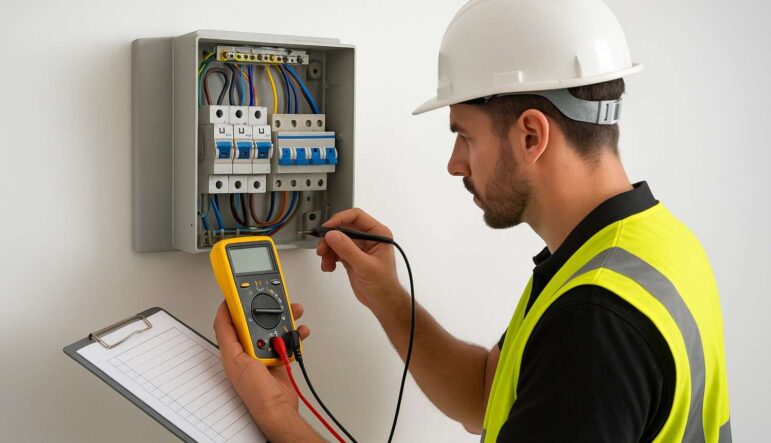
professional electrical wiring testing and inspection services in Ghana
The Two Types of Electrical Inspection and Testing
Electrical inspection and testing falls into two distinct categories, each serving a different purpose and applying to different circumstances.
Initial Verification applies to new electrical installations and to additions or alterations carried out on existing systems. It confirms that the new or modified installation has been designed, constructed, and tested in accordance with the applicable regulations before engineers energise and put it into service.
Periodic Inspection and Testing applies to existing installations already in service. It confirms that the installation remains safe for continued use, identifies deterioration, damage, or non-compliance that has developed since the previous inspection, and establishes the interval at which the next inspection should be carried out.
A skilled and competent person must perform both types of inspection and testing. Competence in this context means a combination of appropriate formal education, practical training, and demonstrable experience that equips the individual to identify electrical hazards and carry out inspection and testing procedures safely and accurately.
General Principles of Electrical Inspection
Before any inspection begins, the person carrying it out must have access to key information about the installation. This includes the fundamental design principles and regulatory requirements that govern the installation, the general characteristics of the system including its supply arrangements, load characteristics, and protective measures, and any available diagrams, charts, circuit schedules, or previous inspection records.
Every engineer must apply safe isolation before any inspection work begins on parts of the installation that are or may be energised. The correct safe isolation procedure involves identifying the circuit or installation to be worked on, isolating it from the supply, securing the isolation against inadvertent re-energisation, and verifying by testing that the circuit is dead before work commences. Failure to follow safe isolation procedures is one of the most common causes of electrical injury to workers carrying out inspection and maintenance activities.
Initial Verification: The Process
Initial verification of a new installation or a new addition to an existing installation follows a defined sequence. Engineers must complete the inspection before testing begins, and the engineer must disconnect the installation from its supply before starting the visual inspection.
Visual Inspection
The visual inspection confirms that the contractor has constructed the installation correctly before any electrical tests are applied. Inspectors verify that all equipment complies with the applicable standards, that engineers have correctly selected and installed all devices for their intended application, and that no visible damage is present to any component or conductor.
The visual inspection covers a comprehensive range of installation details. Engineers verify correct termination and identification of all conductors, appropriate cable routing and protection against mechanical damage, correct installation of fire barriers at penetrations through building elements, correct methods of protection against electric shock, correct segregation of circuits of different voltage levels, adequate access to all switchgear and distribution equipment, and correct placement of all required warning and identification notices.
Testing Procedures
Testing follows the visual inspection and engineers must carry it out using instruments that are appropriate and calibrated for each specific test. Engineers carry out the tests in a defined preferred sequence to ensure that the results of earlier tests do not invalidate or obscure the results of later ones.
The complete sequence of tests for initial verification includes the following.
Continuity of Protective Conductors:
Inspectors use this test to verify that all protective conductors, including circuit protective conductors and the main and supplementary bonding conductors, provide a continuous low-resistance path from every point in the installation to the main earthing terminal. A discontinuous protective conductor means that exposed metalwork may become live in the event of a fault without the fault current being sufficient to operate the protective device.
Continuity of Ring Final Circuit Conductors:
Engineers carry out this test to verify that the line, neutral, and protective conductors of every ring final circuit form a complete, unbroken ring.It also identifies any interconnections between the legs of the ring that create a figure-of-eight arrangement, a common wiring fault that significantly reduces the current-carrying capacity of the ring.
Insulation Resistance:
The engineer applies a DC test voltage between the live conductors and between the live conductors collectively and earth, then measures the resistance of the insulation separating them. A low insulation resistance reading indicates that the insulation has been damaged or has deteriorated to a point where it no longer provides adequate protection against electric shock or leakage current.
Protection by Barriers and Enclosures:
Inspectors use this test to verify that barriers and enclosures genuinely prevent access to all live parts without the use of a key or tool, providing the required degree of protection against accidental contact.
Polarity Test:
The polarity test confirms that all fuses, single-pole switches, and lamp holders are connected in the line conductor only, and securing the isolation to prevent inadvertent re-energisation. Incorrect polarity means that equipment may remain energised when it appears to be switched off, creating a serious shock risk.
Earth Electrode Resistance:
This test applies specifically to installations using a TT earthing arrangement, where the installation earth is provided by a local earth electrode rather than through the supply network. The engineer measures the resistance of the earth electrode to confirm that it is low enough to ensure adequate fault current flow and protective device operation in the event of a fault.
Earth Fault Loop Impedance:
The earth fault loop impedance test measures the total impedance of the fault current path from the supply source, through the line conductor, through a simulated fault at the point being tested, and back through the protective conductor and earthing system to the source. This measurement confirms that in the event of a line-to-earth fault, sufficient current flows to trigger the protective device within the required disconnection time.
RCD Effectiveness and Trip Times:
Engineers test every residual current device to verify correct operation and confirm that it trips within the required time when fault current reaches its rated threshold. This test also confirms that the RCD does not trip on nuisance currents below its rated tripping threshold.
Prospective Fault Current:
The prospective fault current measurement confirms that the fault current flowing during a short circuit or earth fault does not exceed the breaking capacity of the protective devices the engineer has installed. If the prospective fault current exceeds the breaking capacity of a protective device, that device may fail catastrophically rather than interrupting the fault safely.
Phase Sequence:
For three-phase installations, engineers carry out the phase sequence test to confirm that the three phases are connected in the correct rotational sequence. An incorrect phase sequence will cause three-phase motors to rotate in the wrong direction, which can cause serious damage to driven machinery.
Functional Testing:
Functional testing confirms that all switchgear, protective devices, interlocks, and control systems operate correctly under normal operating conditions.
Certification After Initial Verification
Initial verification of a new installation or a new addition to an existing installation follows a defined sequence. Engineers must complete the inspection before testing begins, and the engineer must disconnect the installation from its supply before starting the visual inspection.
Both certificates must be accompanied by schedules of inspection results and test results that document every check and measurement made during the inspection and testing process. Engineers must rectify all defects identified during inspection and testing before issuing any certificate. Issuing a certificate against an installation that contains known defects is a serious professional breach.
Periodic Electrical Inspection and Testing
Periodic inspection and testing of existing installations serves a different purpose from initial verification. Its objective is to confirm that an installation serving a property over time remains in a safe and satisfactory condition for continued use. It is not primarily a fault-finding exercise, though it will identify faults and deficiencies where they exist.
When Periodic Inspection and Testing Is Required
A periodic inspection and test is required in several circumstances. The recommended interval stated on the previous Electrical Installation Condition Report may have expired. Insurance policy conditions, mortgage requirements, or operating licence conditions frequently require a current inspection report. A change of ownership or occupancy also triggers the requirement where no current report exists. Significant additions or alterations to the installation, damage to the system, or the connection of substantially different new loads are all further grounds for commissioning a periodic inspection without waiting for the scheduled interval to expire.
What Periodic Inspection Covers
The scope of a periodic inspection must be agreed between the inspector and the client before work begins, particularly where wiring is concealed within walls, floors, or ceiling voids and access would require significant disruption. Where full access is not practicable, the engineer inspects and tests a representative sample of the installation, clearly noting the limitation in the resulting report.
Inspectors assess the installation against current standards, examining its age, the materials the original contractor used, evidence of corrosion or deterioration, signs of overloading or thermal damage, the performance of existing protective devices, and the influence of external factors such as temperature, humidity, and corrosive substances.
The testing sequence for periodic inspection mirrors that of initial verification, though engineers may adapt the order to suit the circumstances of the specific installation. In some cases, where continuous insulation monitoring devices are installed and confirmed to be functioning correctly, insulation resistance testing of certain circuits may be omitted.
Documentation and Reporting
Inspectors document the outcome of a periodic inspection and test in an Electrical Installation Condition Report (EICR). The engineer compiles the report, recording the results of all inspections and tests, identifies all observations and deficiencies found, and classifies each observation according to its severity using the following coding system.
C1: Danger Present. The property owner or engineer must take immediate remedial action on C1 observations before anyone uses the installation further.
C2: Potentially Dangerous. The engineer must schedule remedial action for C2 observations as soon as practicable.
C3: Improvement Recommended. The observation does not represent an immediate or potential danger but represents a departure from current best practice that would benefit from attention at a suitable opportunity.
FI: Further Investigation Required. Inspectors cannot fully assess the observation without further investigation that was not within the agreed scope of the inspection.
Engineers classify an installation that contains one or more C1 or C2 observations as unsatisfactory. The EICR also states the recommended interval before inspectors should carry out the next periodic inspection, taking into account the type of installation, its age, its condition, and the nature of its use.
Standards and Regulations Governing Electrical Inspection and Testing in Ghana
Electrical inspection and testing in Ghana must comply with the Ghana Electrical Wiring Regulations 2011 (L.I. 2008), which establish the legal framework for electrical installations and the standards to which they must conform.
The following additional standards and guidance documents inform inspection and testing practice. BS 7671:2018, the IET Wiring Regulations, sets out the technical requirements for electrical installations and underpins the Ghana Electrical Wiring Regulations. The Electricity at Work Regulations place a legal duty on employers and employees to maintain electrical systems in a safe condition. IET Guidance Note 3 provides detailed practical guidance on inspection and testing procedures. HSE Guidance Note GS 38 specifies the requirements for the test instruments and test leads that engineers use during electrical inspection and testing.
Why Electrical Inspection and Testing Cannot Be Deferred
The consequences of neglecting electrical inspection and testing are not hypothetical. Electrical installations deteriorate over time through normal use, environmental exposure, and the cumulative effects of thermal cycling, vibration, and moisture ingress. Connections loosen. Insulation ages and cracks. Protective devices fail to operate as specified. Engineers add equipment to circuits without regard for their rated capacity.
None of these deteriorations announce themselves. They develop silently inside walls, above ceilings, and within distribution boards, until a fault strikes. By that point, the damage has already been done.
Regular electrical inspection and testing is the only reliable mechanism for detecting these developing problems before they result in injury, fire, or significant financial loss. Every responsible property owner and facility manager must treat electrical inspection and testing as a fundamental requirement, not a discretionary expenditure.
Mega Solution Electrical Engineering: Professional Electrical Inspection and Testing in Ghana
Mega Solution Electrical Engineering provides comprehensive electrical inspection and testing services for residential, commercial, and industrial installations across Ghana. The Mega Solution Electrical Engineering’s licensed and certified electrical engineers carry out initial verification of new installations and periodic inspection and testing of existing systems in full compliance with the Ghana Electrical Wiring Regulations 2011 and BS 7671.
Our engineers document every inspection to the required standard, with full schedules of inspection and test results, classified observations, and clear recommendations for any remedial work required. The team has the instruments, technical knowledge, and professional experience to deliver inspection and testing services that give property owners, business operators, and facility managers the accurate, reliable information they need to make confident decisions about their electrical infrastructure.
Contact Mega Solution Electrical Engineering today to arrange a professional electrical inspection and testing assessment for your property or facility.
 Posted on Google
 Amos Appiah
Trustindex verifies that the original source of the review is Google.
Thank you Mega Solution Electrical Engineering for your prompt and Professional Electrical Service in Tema Sakumono( C.O.P Sophia Cudjoe Temple) We will always get in touch for further contracts. Good Job!Posted on Google Emmanuel WilsonI hired a licensed electrician from mega solution electrical in Kumasi, the service was done professionally and met all standards. It gave me peace of mind. I will recommend them to every bodyPosted on Google
 Denzel MintahThey’re the best and most reliable electrical company in Ghana I’ll always recommend them to everyonePosted on Google
 Jessica NgThanks for solving our electrical problem so fast, coming all the way to Cantonments.Posted on Google
 Charles Adom-OpokuMega Solution demonstrates exceptional expertise in genset systems. Their professionalism, technical proficiency, and industry experience set them apart. I highly recommend their services to anyone seeking reliable and knowledgeable partners in this field.Posted on Google
 Giuseppe M_CThis best experience I had in a while, Richard provided all the help I was looking for. Thank you, this is a 10 Stars service!Posted on Google
 Joseph OtooBest electrical company in GhanaPosted on Google
 Junior JesusBest Electrician in Ghana | best electrical engineer at good location | over 30 years experience | good electrical service. Thank you so much. I’m very happy
When searching for a reliable electrician, call us at +233 24 415 1232 We specialize in electrical repairs, indoor and outdoor lighting installations, panel upgrades, and even hot tub wiring!
Always Hire Professional Electrical Energy and Power Auditors
No matter how urgent an electrical repair may seem, attempting to handle it without professional training is never acceptable. Untrained intervention in electrical systems is extremely dangerous, both to the person attempting the work and to everyone in the building. Even if no immediate injury occurs, an incomplete or incorrectly executed repair can leave hidden faults that pose a serious and ongoing risk to the property and everyone who occupies it. Electrical problems require a certified electrician. There are no safe shortcuts. Visit Our Google Business Profile
Electrical Power and Wiring Audit in Accra – Ghana
Mega Solution Electrical Engineering understands that electrical problems are disruptive, stressful, and often urgent. That is why our team responds to every service request as quickly as possible, minimising disruption to your home, business, or facility. Every technician we deploy is licensed, professionally trained, and verified to the highest standard, giving you complete confidence in the quality and safety of every job we carry out. Our comprehensive electrical services cover all your needs including:
- Generator Installation and Repair Services
- Best Industrial Electrical Automation services
- Best Electric Motor Rewinding Services
- Earthing Installations and Upgrades Services
- Electro-Mechanical services
- Lighting Installation
- Residential Electrical Installation Services
- Electrical Panel Replacement
- LED Lighting
- Industrial electrical Installation Services
- Electrical Troubleshooting and Repairs
- Professional Electrical Support and Training Services
- Electrical Wiring Design and Engineering Services
- Electrical Energy and Power Auditing Services
- Distribution Panels Fabrication and Upgrades Services
- Professional electrical contractors in Ghana
- Commercial electrical Installation Services
- Licensed Electricians in Ghana
- Home Wiring
- Consulting and Advisory services
- Electrical Wirings Testing and Inspection Services
- Wiring Replacement and Upgrade Services
- Residencial, commercial and Industrial wiring Services

Mega Solution Electrical Engineering Ltd
Mega Solution Electrical Engineering Ltd, a licensed and certified electrical engineering company in Ghana specializing in electrical contracting, generator maintenance, energy audits, and industrial electrical services.
Search
Electrical Wiring Contract – What Can Go Wrong or Right
Generator Service Experts in Ghana, When the Lights Go Out – Mega Solution Electrical to the Rescue!
Categories
- Certified Electricians Ghana
- Earthing Installations
- Earthing Maintenance
- Electrical Consulting
- Electrical Contractors
- Electrical Installation Ghana
- Electrical Maintenance Ghana
- Electrical Repair Ghana
- Electrical Safety
- Electrical Training
- Energy Auditing
- Engineering Services
- Generator Installation
- Generator Maintenance Ghana
- Generator Repair
- Generator Services
- Generator Servicing Ghana
- Ghana Electrical Licensing
- Ghana Electrical Services
- Installation Services
- Licensed Electricians
- Motor Rewinding
- Residential Electrical Service
Archive
| M | T | W | T | F | S | S |
|---|---|---|---|---|---|---|
| 1 | 2 | 3 | 4 | |||
| 5 | 6 | 7 | 8 | 9 | 10 | 11 |
| 12 | 13 | 14 | 15 | 16 | 17 | 18 |
| 19 | 20 | 21 | 22 | 23 | 24 | 25 |
| 26 | 27 | 28 | 29 | 30 | 31 | |
Tags
- Agricultural Engineering
- Cable Sizing
- Commercial Electrical Contracting
- Earthing Installations and Upgrades Services
- Earthing Systems
- Earthing System Upgrades
- Electrical Advisory Service
- Electrical Company
- Electrical Contractors in Ghana
- Electrical Design Ghana
- Electrical Energy and Power Auditing Services
- Electrical Energy Auditing
- Electrical Load Calculation
- Electrical Panel Upgrades
- Electrical Repair Services
- Electrical Safety Training Ghana
- Electrical Services Ghana
- Electrical Training Services Ghana
- Electrical Troubleshooting
- Electrical Wiring Certificate Ghana
- Electrical Wiring Design and Engineering Services
- Electrical Wiring Design Ghana
- Electrical Wiring Installation
- Electrical Wiring Upgrades
- Electrical Workshop Training
- Electricians
- Electricians in Ghana
- Engineering Services Ghana
- Generator experts in Ghana
- Generator Installation and Repair Services
- Generator Maintenance Contracts
- Generator Maintenance Ghana
- Generator Repair Services
- Industrial Electrical Wiring
- Industrial Generator Maintenance
- Industrial generator repair services
- Licensed Electrical Contractors Ghana
- Licensed Electricians in Ghana
- Lightning Protection Systems
- Power Auditing Services
- Professional Electrical Support
- Residential Electrical Installation Ghana
- Three Phase Power
- Voltage Drop
- Workplace Electrical Safety
Prayer Warfare
Recent Comments
