
Home / Blog Posts / Electrical Contractor in Ghana: What to Look For
12 Oct, 2026
Posted by Mega Solution Electrical Engineering Ltd
0 comment
Electrical Contractor in Ghana: What to Look For
The wrong contractor doesn’t just deliver a bad job. They can leave a property with hidden fire risks that stay invisible for years. Choosing an electrical contractor in Ghana feels straightforward until you’re actually facing the decision. Dozens of people advertise electrical work across any given town. Not all of them are legally entitled to do it. Fewer still have the qualifications to do it well. This guide explains exactly what separates a genuinely competent electrical contractor in Ghana from someone who simply owns a tool bag. It covers registration, certification, insurance, and the questions worth asking before any contract gets signed.
Electrical Contractor in Ghana: The Complete Guide for Homeowners, Businesses, and Engineers
Every electrical installation in Ghana depends on the competence of whoever carries it out. This holds whether it’s a single-room rewire or a full industrial plant. Get this choice right, and the installation performs safely for decades. Get it wrong, and the consequences range from nuisance faults to fire, electric shock, or catastrophic equipment failure.
This guide is written for anyone who needs to hire an electrical contractor in Ghana. It’s for those who want to know how to tell the qualified from the unqualified. That includes homeowners planning a renovation, facility managers overseeing commercial premises, and engineers vetting subcontractors on larger projects. The regulatory framework covered here applies nationally. The underlying principles apply anywhere in the world.
Contractor or Handyman Electrician? Knowing the Difference
Many people advertising electrical work in Ghana operate informally, without registration, insurance, or any accountability beyond a verbal promise. This doesn’t automatically mean the work is unsafe. Some informal electricians are genuinely skilled. But it does mean the client carries all the risk if something goes wrong, since there’s no registered business, no insurance policy, and no certification standing behind the work.
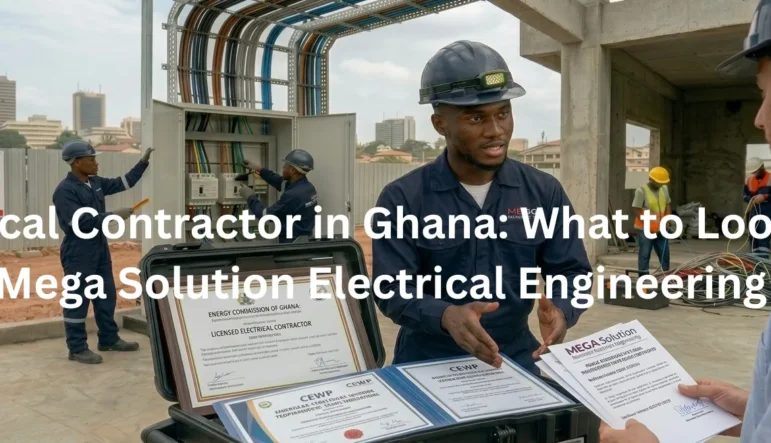
A registered electrical contractor in Ghana operates as an accountable business. They issue an Electrical Installation Certificate bearing their licence number. This certificate creates a documented, traceable record tying the completed work to a specific, identifiable, and legally accountable party. If a fault later develops, this record matters enormously, both for insurance purposes and for establishing who bears responsibility for the repair.
The price difference between a registered contractor and an informal electrician can be significant, particularly for smaller domestic jobs. But that difference reflects real costs the registered contractor carries: insurance premiums, ongoing certification, and the overhead of operating a properly structured, accountable business. Viewed against the potential cost of an uninsured failure, that price gap often represents good value rather than an unnecessary expense.
Why Contractor Selection Matters More Than It Seems
Electrical work looks deceptively simple from the outside. Wires get connected, switches get fitted, and the lights come on. But what happens behind the wall, or inside the distribution board, determines whether that installation stays safe for the next twenty years.
An unqualified electrical contractor in Ghana can produce work that looks finished on the day it’s completed. The real risk shows up later. Undersized cables overheat gradually under load. Poor earthing leaves a property without proper fault protection. Loose terminations loosen further with vibration and thermal cycling, eventually arcing. None of these faults are visible during a casual walkthrough. None of them show up until something fails.
This is why selecting a properly qualified electrical contractor in Ghana matters more than most property owners initially assume. The upfront cost difference between a registered, insured contractor and an unregistered one is often modest. The downstream cost difference can be enormous. It shows up in fire risk, in insurance claims that get rejected, and in the cost of correcting substandard work later.
The Hidden Cost of Getting This Choice Wrong
Property owners rarely see the full cost of hiring an unqualified contractor at the time. The bill arrives later, often years later, when a fault finally surfaces. By then, the original contractor is usually long gone. The property owner is left covering repair costs alone, sometimes alongside a rejected insurance claim, because the original work never met the standard the policy required. This delayed cost is exactly why the vetting process matters before work begins, rather than after something goes wrong.
Energy Commission Registration: The Legal Baseline
Under the Ghana Electrical Wiring Regulations 2011, known as L.I. 2008, only Certified Electrical Wiring Professionals are legally entitled to carry out indoor electrical wiring work in Ghana. This isn’t a recommendation. It’s a legal requirement, enforced under the Energy Commission Act 1997, Act 541.
The Energy Commission maintains a register of contractors who have met the technical and professional standards required to work legally. Hiring someone outside this register isn’t simply a risk to installation quality. It’s a decision that can invalidate building insurance. It can also expose the property owner to regulatory liability if something goes wrong later.
CEWP Certification Classes: Domestic, Commercial, and Industrial
The Energy Commission’s certification framework doesn’t use a lettered class system. Instead, it splits certification by the scope of work involved. Domestic Class certification covers homes, apartments, and similar residential properties. Commercial Class certification covers larger premises such as hotels, schools, banks, and shopping malls. Industrial Class certification covers factories, processing plants, and heavy industrial installations.
This distinction matters in practice. A contractor certified for domestic work isn’t automatically qualified for industrial installations. Nor are they legally entitled to carry them out. When vetting an electrical contractor in Ghana for a commercial or industrial project, confirm the specific class of certification held. Don’t stop at confirming that a certification simply exists.
Separate from these electrician classes, the Energy Commission also certifies Inspectors. These are Certified Electrical Wiring Professional Inspectors and Certified Electrical Wiring Inspectors. Their role is to verify completed installations independently. Their certification sits above the standard electrician classes in terms of assessment authority.
What Registration Actually Confirms (and What It Doesn’t)
Energy Commission registration confirms that a contractor has passed the required examinations. These cover oral interviews, an objective test, and a practical assessment. It confirms a baseline level of technical competence recognised under Ghanaian law.
What it doesn’t automatically confirm is business reliability, insurance cover, or the specific depth of experience needed for a complex project. Registration is the legal minimum, not a complete quality guarantee on its own. Think of it as the starting filter, not the final decision.
Beyond Registration: Insurance and Liability Cover
A registered electrical contractor in Ghana can still leave a client financially exposed if something goes wrong during the work itself. This is separate from any fault in the finished installation. It’s where insurance cover becomes essential, and it’s a detail many property owners never think to ask about.
Public Liability Insurance
Public liability insurance covers damage or injury caused to third parties during the course of the work. Suppose a contractor’s team accidentally damages property, or a member of the public is injured on site. Public liability cover is what protects both the contractor and, indirectly, the client from an uninsured claim landing on their doorstep.
Mega Solution Electrical Engineering carries public liability insurance as standard across its work. Any electrical contractor in Ghana handling commercial or industrial projects should be able to confirm the same without hesitation. The exposure to third-party risk is simply higher on these larger sites.
Workmen’s Compensation Cover
Workmen’s compensation cover protects a contractor’s own employees in the event of injury while working on site. This matters to clients too, not just to the contractor’s staff. A serious injury on an uninsured job can trigger legal disputes that draw the property owner in. This applies particularly on commercial sites, where health and safety obligations extend to whoever controls the premises.
Mega Solution maintains workmen’s compensation cover alongside public liability insurance. Asking directly whether a prospective electrical contractor in Ghana holds both, not just one, is a reasonable question on any project of meaningful scale. It’s also an increasingly necessary one.
Engineering Qualifications and Professional Membership
Registration and insurance establish a baseline. Beyond that baseline, the depth of technical leadership behind a contracting business often determines how well it handles anything outside routine, straightforward work.
What GhIE Membership Signals
The Ghana Institution of Engineers is the country’s professional body for engineers. Membership requires meeting defined standards of qualification and ongoing professional conduct. A contracting business led by a GhIE member brings a level of formal engineering accountability that a purely trade-qualified operation doesn’t necessarily offer.
Mega Solution Electrical Engineering is led by a degree-qualified electrical engineer and Member of the Ghana Institution of Engineering. This leadership brings eighteen years of continuous professional experience in Ghana, dating back to 2008. This combination of formal engineering education and sustained practical experience matters particularly on projects involving load calculations, distribution design, or fault diagnosis that goes beyond routine wiring.
Degree-Qualified Engineers vs. Trade-Only Contractors
Not every capable electrician holds a degree. Trade qualification alone doesn’t disqualify a contractor from doing excellent work on straightforward domestic jobs. But for anything involving design decisions, engineering-level qualification becomes genuinely valuable rather than a nice-to-have. This includes sizing a distribution panel, calculating a facility’s total load, or diagnosing an intermittent industrial fault.
When evaluating an electrical contractor in Ghana for anything beyond routine wiring, ask specifically who within the business holds engineering qualifications. Ask what role that person plays on the actual project. A business that subcontracts all technical decisions to unnamed staff offers far less accountability than one where a named, qualified engineer takes direct responsibility.
What a Site Visit Should Tell You
A proper electrical contractor in Ghana will want to visit the site before quoting on anything beyond the simplest job. This visit itself reveals useful information. A contractor who quotes a firm price over the phone, without ever seeing the property, is either working from very limited information or padding the price to cover unknown risk. Neither is a good sign.
During a genuine site visit, a competent contractor asks specific questions about the existing installation, the intended use of the space, and any known issues. They inspect the existing distribution board, check available capacity, and look for signs of previous poor workmanship. This level of engagement, before a single wire is touched, is a strong indicator of how carefully the actual work will be carried out.
Track Record and Experience
Years in business is a commonly cited credential, but it’s worth interrogating rather than accepting at face value. A contractor operating for eighteen years has, in principle, weathered enough projects to develop genuine expertise. But longevity alone doesn’t guarantee quality. It needs backing from the registration, insurance, and qualification details covered above.
Request examples of completed projects similar in scale and type to your own. A contractor experienced in domestic rewiring isn’t automatically the right choice for an industrial installation. The reverse holds true too. Relevant experience, matched to the specific project, matters more than years in business as a standalone figure.
How to Verify a Contractor’s Claimed Experience
Claimed experience is easy to state and harder to verify, so it’s worth asking for something more concrete than a number of years. Request photographs of completed projects, ideally with enough detail to show the quality of workmanship rather than just a finished, painted-over wall. Ask for the names of two or three previous clients willing to speak about the work directly. A contractor confident in their own track record will offer this readily. One who hesitates, or offers only vague generalities, is worth treating with more caution.
Warning Signs of an Unqualified Contractor
Certain patterns should prompt immediate caution when vetting an electrical contractor in Ghana. A contractor who can’t produce evidence of Energy Commission registration is the clearest warning sign of all. This applies especially if they become evasive when asked directly.
Unusually low quotes, well below every other estimate received, often reflect corners being cut. This might involve materials, testing, or proper certification rather than genuine efficiency. A contractor unwilling to provide a written quote, insisting instead on an informal verbal price, leaves no documented record if disputes arise later. Similarly, a contractor who can’t name the specific standards they follow, such as the Ghana Wiring Regulations or relevant IEC standards, often lacks the technical grounding those standards represent.
A contractor reluctant to provide references from previous clients deserves real caution. So does one unable to produce evidence of insurance cover when asked directly. This holds regardless of how competitive their price appears on paper.
Questions to Ask Before Hiring
A short, direct set of questions reveals more about a contractor’s genuine competence than any amount of marketing material. Start by requesting their Energy Commission registration number, then verify it independently rather than taking it on trust. Confirm which certification class they hold, domestic, commercial, or industrial, and check it matches the scope of your project.
Insurance comes next. Confirm whether they carry public liability insurance and workmen’s compensation cover, and request evidence rather than a verbal assurance. Find out who, specifically, will be responsible for technical decisions on your project, along with their qualifications. Request a written, itemised quote rather than a single bottom-line figure, and ask what testing they perform before signing off completed work.
Finally, request references from at least two previous clients with projects similar to yours. Actually follow up with them, rather than treating the offer as a box-ticking formality.
Getting a Fair Quote: What Should Be Itemised
A properly itemised quote from an electrical contractor in Ghana should separate labour, materials, and testing into distinct line items. This is far more transparent than bundling everything into a single figure. This transparency allows a fair comparison between contractors. It also makes it far easier to spot where corners might be cut.
Materials should be specified by brand or standard where relevant, not left as a vague “electrical materials” line. Testing and certification costs should appear explicitly, rather than being assumed as included. This covers the issuing of an Electrical Installation Certificate bearing the contractor’s licence number. A quote that lacks this detail makes it difficult to judge whether the price reflects genuine value, or simply a lower standard of work.
Comparing Quotes Without Comparing Like for Like
The biggest mistake property owners make when comparing quotes is treating the lowest number as the best value. Two quotes for what appears to be the same job can differ substantially in scope, even when the headline figure looks similar. One contractor’s quote might include full testing and certification. Another’s might not, simply omitting that cost to appear more competitive. Reading each quote’s itemised breakdown carefully, rather than jumping straight to the total, is the only reliable way to compare offers fairly.
Residential vs. Commercial vs. Industrial Contractors: Do You Need a Specialist?
Not every electrical contractor in Ghana suits every type of project. Matching the contractor’s certification class and experience to the project type matters more than many clients realise. A contractor with strong domestic experience may lack the load calculation expertise, three-phase familiarity, or industrial safety protocols required on a factory floor.
Commercial projects, such as hotels, schools, or retail premises, often involve higher occupancy loads than domestic work. They also carry stricter compliance requirements, even when the underlying wiring principles are similar. Industrial projects add further complexity again. These involve motor control centres, three-phase distribution, and equipment that operates continuously under heavy load. Confirming a contractor’s certification class, and asking directly about relevant project experience, avoids the mismatch that leads to underqualified work on a project that genuinely needed specialist expertise.
After the Work Is Done: What to Expect
A properly completed job doesn’t end when the last wire is connected and the lights come on. A genuine electrical contractor in Ghana provides a completed Electrical Installation Certificate, documenting the work carried out and confirming it meets the required standard. This certificate should reference the specific standards followed, such as the Ghana Wiring Regulations, and should bear the contractor’s registration details.
Ask what warranty or workmanship guarantee applies to the completed installation, and get this in writing rather than as a verbal assurance. A contractor confident in their work will typically offer some period of guarantee against defects, separate from any manufacturer warranty on materials used. Mega Solution provides a 12-month workmanship guarantee on completed installations as standard. The absence of any warranty offer, or vague resistance when the question is raised, is worth treating as a caution sign alongside the others covered in this guide.
Finally, ask whether the contractor offers any form of follow-up inspection or maintenance service. This matters particularly for larger commercial or industrial installations, where periodic testing forms part of ongoing compliance rather than a one-time event. Mega Solution recommends periodic inspection every 5 years for commercial premises, every 3 years for industrial installations, and every 5 to 10 years for domestic properties depending on occupancy, in line with UK BS 7671 guidance where Ghanaian regulation doesn’t specify a fixed interval.
Frequently Asked Questions
Registration and Qualifications
How do I verify a contractor’s Energy Commission registration? The Energy Commission maintains a register of certified contractors. Registration can be verified directly through the Commission, rather than relying solely on documents the contractor provides.
Is a cheaper unregistered contractor ever worth the risk? Generally no. The upfront saving is often modest compared to the potential cost of fire damage, rejected insurance claims, or correcting substandard work discovered later.
Do I need an engineer, or is a certified electrician enough? For routine domestic wiring, a certified electrician is typically sufficient. For anything involving design decisions, load calculations, or industrial-scale work, engineering-level qualification adds real value and reduces risk.
What’s the difference between a contractor and an inspector? Contractors carry out the electrical work itself. Inspectors, certified separately by the Energy Commission, verify completed installations independently. They can identify faults a contractor might miss or overlook.
Can a contractor be registered but still do poor-quality work? Yes. Registration confirms a legal baseline of competence, not a guarantee of quality on every job. This is why references, insurance checks, and a properly itemised quote all still matter, even once registration is confirmed.
Cost, Process, and Aftercare
Should I get multiple quotes before hiring? Yes. Multiple itemised quotes allow a fair comparison of price, scope, and the specific standards each contractor commits to. This makes it easier to spot outliers on either end.
What happens if I hire an unregistered contractor and something goes wrong? Beyond the safety risk, unregistered work can invalidate building insurance. It can also expose the property owner to regulatory liability, since responsibility shifts back to whoever commissioned the unregistered work.
How long should the vetting process take before hiring? For a straightforward domestic job, verifying registration and requesting a written quote can often be done within a few days. For larger commercial or industrial projects, allowing a week or two to properly check references and confirm insurance cover is a reasonable investment given the scale of the work involved.
What should I do if I already hired an unregistered contractor? Arrange an independent inspection from a registered contractor or a Certified Electrical Wiring Inspector as soon as possible. This confirms whether the completed work meets required safety standards, and identifies any faults that need correcting before they become dangerous.
The Bottom Line
Choosing an electrical contractor in Ghana comes down to verifying a handful of specific, checkable facts. This matters more than relying on impressions or price alone. Energy Commission registration, matched to the correct certification class, is the legal baseline. Public liability and workmen’s compensation insurance protect against risks the registration itself doesn’t cover. Engineering qualifications and professional membership, where relevant to the project’s complexity, add a further layer of accountability.
None of these checks take long to carry out. Every one of them can be verified before any contract is signed. Mega Solution Electrical Engineering meets each of these standards directly. The business is Energy Commission registered, led by a GhIE member with eighteen years of continuous experience since 2008, and carries both public liability and workmen’s compensation insurance as standard.
For homeowners, facility managers, or engineers evaluating an electrical contractor in Ghana for an upcoming project, contact Mega Solution Electrical Engineering. A written quote and a direct conversation about the specific qualifications and cover behind the work are the natural next step.
Work With a Professional Electrical Contractor in Ghana
No matter how urgent an electrical project becomes, choosing an electrical contractor without checking competence, documentation, and safety practice can create serious long-term risk. Poor design, weak supervision, and undocumented work can lead to faults, delays, compliance issues, and unsafe installations. Always engage Mega Solution Electrical Engineering Ltd for professional electrical contracting, installation, inspection, maintenance, and project support services in Ghana. Visit Our Google Business Profile
Mega Solution Electrical Engineering Ltd – Electrical Contractor Services in Ghana
Our electrical contracting team supports homeowners, developers, businesses, consultants, and facility managers with properly planned and supervised electrical work. We handle wiring, panel installation, testing, troubleshooting, maintenance, upgrades, and industrial electrical support with clear communication and attention to safety. We can assist with all your electrical needs including:
- Generator Installation and Repair Services
- Best Industrial Electrical Automation services
- Best Electric Motor Rewinding Services
- Earthing Installations and Upgrades Services
- Electro-Mechanical services
- Lighting Installation
- Residential Electrical Installation Services
- Electrical Panel Replacement
- LED Lighting
- Industrial electrical Installation Services
- Electrical Troubleshooting and Repairs
- Professional Electrical Support and Training Services
- Electrical Wiring Design and Engineering Services
- Electrical Energy and Power Auditing Services
- Distribution Panels Fabrication and Upgrades Services
- Professional electrical contractors in Ghana
- Commercial electrical Installation Services
- Licensed Electricians in Ghana
- Home Wiring
- Consulting and Advisory services
- Electrical Wirings Testing and Inspection Services
- Wiring Replacement and Upgrade Services
- Residencial, commercial and Industrial wiring Services
When searching for a reliable electrical contractor in Ghana, call us at +233 24 415 1232. We specialise in residential, commercial, and industrial electrical installation, wiring design, panel upgrades, inspection and testing, fault finding, maintenance, and project electrical support.

Mega Solution Electrical Engineering Ltd
Mega Solution Electrical Engineering Ltd, a licensed and certified electrical engineering company in Ghana specializing in electrical contracting, generator maintenance, energy audits, and industrial electrical services.
Search
Electrical Wiring Contract – What Can Go Wrong or Right
Generator Service Experts in Ghana, When the Lights Go Out – Mega Solution Electrical to the Rescue!
Categories
- Certified Electricians Ghana
- Earthing Installations
- Earthing Maintenance
- Electrical Consulting
- Electrical Contractors
- Electrical Installation Ghana
- Electrical Maintenance Ghana
- Electrical Repair Ghana
- Electrical Safety
- Electrical Training
- Energy Auditing
- Engineering Services
- Generator Installation
- Generator Maintenance Ghana
- Generator Repair
- Generator Services
- Generator Servicing Ghana
- Ghana Electrical Licensing
- Ghana Electrical Services
- Installation Services
- Licensed Electricians
- Motor Rewinding
- Residential Electrical Service
Archive
| M | T | W | T | F | S | S |
|---|---|---|---|---|---|---|
| 1 | 2 | 3 | 4 | |||
| 5 | 6 | 7 | 8 | 9 | 10 | 11 |
| 12 | 13 | 14 | 15 | 16 | 17 | 18 |
| 19 | 20 | 21 | 22 | 23 | 24 | 25 |
| 26 | 27 | 28 | 29 | 30 | 31 | |
Tags
- Agricultural Engineering
- Cable Sizing
- Commercial Electrical Contracting
- Earthing Installations and Upgrades Services
- Earthing Systems
- Earthing System Upgrades
- Electrical Advisory Service
- Electrical Company
- Electrical Contractors in Ghana
- Electrical Design Ghana
- Electrical Energy and Power Auditing Services
- Electrical Energy Auditing
- Electrical Load Calculation
- Electrical Panel Upgrades
- Electrical Repair Services
- Electrical Safety Training Ghana
- Electrical Services Ghana
- Electrical Training Services Ghana
- Electrical Troubleshooting
- Electrical Wiring Certificate Ghana
- Electrical Wiring Design and Engineering Services
- Electrical Wiring Design Ghana
- Electrical Wiring Installation
- Electrical Wiring Upgrades
- Electrical Workshop Training
- Electricians
- Electricians in Ghana
- Engineering Services Ghana
- Generator experts in Ghana
- Generator Installation and Repair Services
- Generator Maintenance Contracts
- Generator Maintenance Ghana
- Generator Repair Services
- Industrial Electrical Wiring
- Industrial Generator Maintenance
- Industrial generator repair services
- Licensed Electrical Contractors Ghana
- Licensed Electricians in Ghana
- Lightning Protection Systems
- Power Auditing Services
- Professional Electrical Support
- Residential Electrical Installation Ghana
- Three Phase Power
- Voltage Drop
- Workplace Electrical Safety
Prayer Warfare
Recent Comments
