

Home / Blog Posts / Circuit Breaker Ratings: Complete Engineering Guide
28 Jun, 2025
Posted by Mega Solution Electrical Engineering Ltd
2 comments
Circuit Breaker Ratings: Complete Engineering Guide
Circuit breaker ratings determine whether an electrical installation is safe, correctly protected, and compliant with international standards. Selecting a breaker on current rating alone is one of the most dangerous specification errors in electrical engineering. Every marking on a circuit breaker label carries precise technical meaning. Those markings directly affect installation safety, equipment protection, and the lives of everyone who works and lives within the building. This complete guide to circuit breaker ratings covers every major specification parameter and explains the international standards that govern them. It provides practical selection guidance for engineers, electricians, and learners worldwide.
Circuit Breaker Ratings: The Complete Technical Reference for Engineers, Electricians, and Learners
What Is a Circuit Breaker and Why Do Ratings Matter
A circuit breaker is an automatic switching device that protects an electrical circuit against damage from overcurrent. It detects fault conditions including overloads and short circuits and interrupts current flow automatically to prevent cable damage, equipment failure, and fire.
Unlike a fuse, a circuit breaker resets after operation and can be used repeatedly. This makes correct rating selection even more critical. A fuse that blows on a fault is replaced with a correctly rated replacement. A circuit breaker that operates on a fault is reset and continues to protect the circuit. If that breaker was incorrectly rated for the installation it continues to provide inadequate protection indefinitely.
How a Circuit Breaker Works
A circuit breaker uses two distinct tripping mechanisms working together to provide protection across the full range of fault conditions.
The thermal element uses a bimetallic strip that bends when heated by sustained overcurrent. As current exceeds the rated value the strip heats progressively. Eventually it bends sufficiently to release the trip mechanism. This thermal response provides overload protection with a time delay proportional to the degree of overload. A small overload trips the breaker slowly. A large overload trips it faster.
The magnetic element uses an electromagnetic coil that generates a magnetic field proportional to current. When current reaches the magnetic trip threshold the field pulls an armature that releases the trip mechanism instantly. This magnetic response provides short circuit protection with essentially no intentional time delay. Short circuit currents are interrupted within milliseconds.
Together these two mechanisms protect against both sustained overloads that damage cables through progressive heating and sudden short circuits that cause immediate catastrophic damage if not interrupted within milliseconds.
Modern moulded case circuit breakers and air circuit breakers replace or supplement these mechanical elements with electronic trip units. Electronic trip units provide adjustable protection functions with precise current and time settings that mechanical elements cannot match. We cover electronic trip units in detail in a dedicated section below.
Why Incorrect Ratings Cause Failures and Safety Hazards
An undersized circuit breaker trips unnecessarily on normal load current. Operations are disrupted. Equipment suffers repeated power interruptions. Maintenance personnel waste time investigating spurious trips.
An oversized circuit breaker fails to trip on fault current that exceeds the cable’s current carrying capacity. Cables overheat. Insulation degrades. Fire risk increases progressively. In the worst case an oversized breaker allows fault current to flow long enough to ignite surrounding materials. It interrupts only after the damage is done.
A breaker with insufficient breaking capacity may explode or weld its contacts closed on fault currents above its rating. A breaker with welded contacts provides no protection whatsoever from that point forward. Every circuit breaker rating exists to prevent one of these failure modes.
IEC 60898 Versus IEC 60947-2: Which Standard Applies
Two primary international standards govern circuit breaker ratings globally. Understanding which standard applies to your installation is the first step in correct specification.
IEC 60898 covers circuit breakers for overcurrent protection in household and similar installations. These are the breakers used in domestic consumer units and light commercial distribution boards. IEC 60898 breakers are tested and rated for use by non-skilled persons in fixed installations. They have standardised current ratings, fixed tripping characteristics, and simplified marking requirements compared to industrial breakers.
IEC 60947-2 covers low voltage circuit breakers for industrial and commercial applications specifically. These are moulded case circuit breakers and air circuit breakers used in industrial motor control centres, main distribution boards, and commercial installations with significant load complexity. IEC 60947-2 breakers offer a much wider range of ratings, adjustable protection functions, and specialist accessories that IEC 60898 breakers do not provide.
Specifying an IEC 60898 breaker in an industrial application where IEC 60947-2 is required is a serious engineering error. The IEC 60898 breaker may appear to function correctly under normal conditions but lacks the breaking capacity, short time withstand capability, and coordination capability required for reliable fault protection in an industrial environment.
The Complete Circuit Breaker Ratings Explained
Every marking on a circuit breaker label is a standardised rating with a precise technical definition. Engineers must understand every rating before specifying a breaker for any application. Learners who understand these ratings develop the foundation for confident electrical specification throughout their careers.
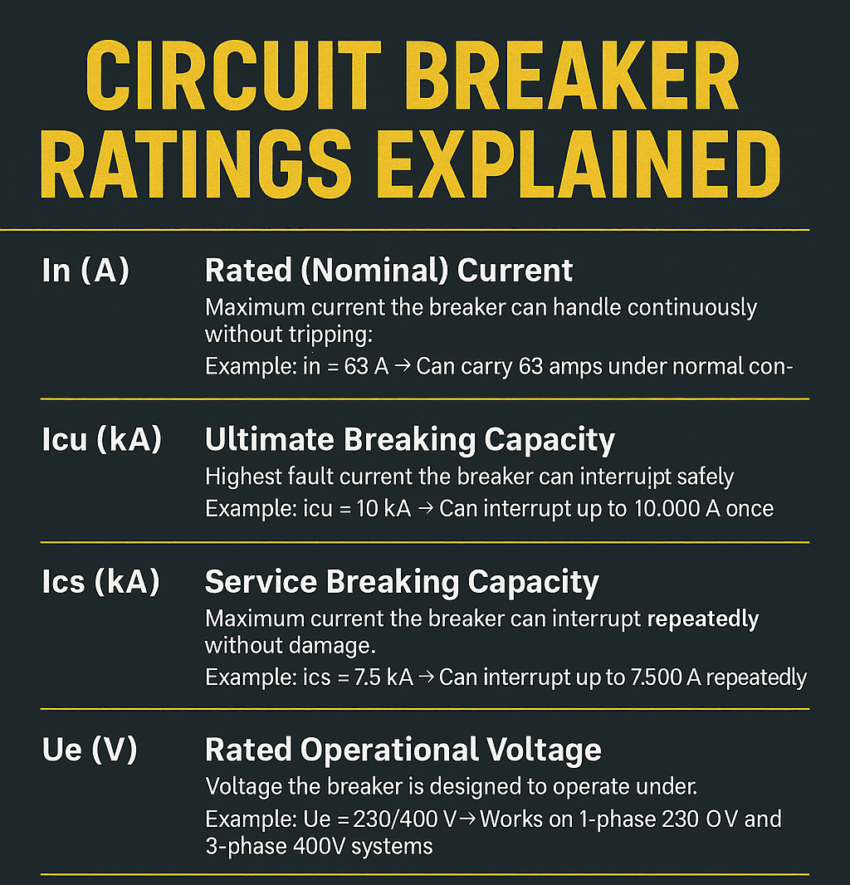
In (A): Rated Current
The rated current, designated In and expressed in amperes, is the maximum current the breaker carries continuously without tripping under reference conditions. Reference conditions are defined in the applicable standard as a specific ambient temperature, typically 30 degrees Celsius for IEC 60898 and 40 degrees Celsius for IEC 60947-2, with the breaker mounted in a specified enclosure or on a specified busbar system.
Rated current selection must satisfy the fundamental cable protection relationship:
Ib ≤ In ≤ Iz
Where Ib is the design current of the circuit, In is the breaker rated current, and Iz is the current carrying capacity of the protected cable. The breaker In must be equal to or greater than the design current and equal to or less than the cable current carrying capacity. This relationship is the foundation of correct overcurrent protection design as specified in IEC 60364.
Standard IEC 60898 rated current values follow a preferred number series including 6, 10, 16, 20, 25, 32, 40, 50, 63, 80, 100, and 125 amperes. IEC 60947-2 moulded case breakers are available in a much wider range from as low as 0.5 amperes to several thousand amperes for large air circuit breakers.
Icu (kA): Ultimate Breaking Capacity
The ultimate breaking capacity is designated Icu and expressed in kiloamperes. It is the maximum prospective fault current the breaker interrupts under defined test conditions. After interrupting a fault at Icu the breaker may sustain internal damage. It is not required to remain serviceable for further operation.
Icu testing follows the standard O-t-CO test sequence defined in IEC 60947-2. The sequence involves an Opening operation at fault current, a time interval t, and a Close-Opening operation. The test circuit power factor directly affects the difficulty of fault current interruption. IEC 60947-2 Table 11 specifies test power factors of 0.1 to 0.2 for breaking capacities above 100 kA, 0.2 for 50 to 100 kA, 0.3 for 20 to 50 kA, 0.5 for 6 to 20 kA, and 0.7 for below 6 kA.
Engineers must verify that the breaker’s Icu applies at the actual power factor of the installation’s fault circuit. The Icu marked on the breaker is tested at the standard power factor for its breaking capacity range. At lower power factors the actual breaking capacity may be reduced below the marked value. Always verify the breaking capacity at the installation’s actual fault power factor from the manufacturer’s technical data.
Never select a breaker with Icu below the prospective short circuit current at the installation point. This is a critical safety error. Calculate the prospective short circuit current at every distribution board. Use the supply transformer impedance, the cable impedance between transformer and board, and any other impedances in the fault current path.
Ics (kA): Service Breaking Capacity
The service breaking capacity, designated Ics and expressed in kiloamperes, is the maximum fault current the breaker interrupts while remaining fully serviceable for continued operation without replacement or maintenance.
After interrupting a fault at Ics the breaker must pass the specific verification test sequence defined in IEC 60947-2 to confirm it remains serviceable. This post-Ics test sequence is more demanding than the post-Icu sequence because it must confirm that the breaker’s protective function is fully intact after service duty fault interruption, not merely that the fault was cleared.
Ics is expressed either as an absolute value in kiloamperes or as a percentage of Icu. IEC 60947-2 specifies preferred Ics values of 25%, 50%, 75%, and 100% of Icu. For installations where breakers must remain serviceable after fault interruption without immediate replacement, specify Ics equal to or greater than the prospective short circuit current. This requirement is particularly important in remote installations where breaker replacement is difficult and in critical facilities where rapid restoration of service after a fault is essential.
Icw (kA): Rated Short Time Withstand Current
The rated short time withstand current, designated Icw and expressed in kiloamperes with a specified duration, is the fault current a breaker carries for the specified time without sustaining damage. IEC 60947-2 specifies Icw for durations of 0.05, 0.1, 0.25, 0.5, and 1 second. For durations shorter than 1 second the allowable Icw is higher than the 1 second value because the thermal energy the breaker absorbs during the shorter period is lower.
Icw is fundamental to discrimination and selectivity in cascaded protection systems. An upstream breaker with adequate Icw carries the fault current for the time delay period while a downstream breaker operates to clear the fault. After the downstream breaker clears the fault the upstream breaker resets without damage.
A breaker with high Icu but insufficient Icw cannot provide reliable time graded protection. It may interrupt the fault correctly but sustain internal damage during the intentional time delay period. This damage compromises its future protective function. IEC 60947-2 includes Icw ratings for moulded case and air circuit breakers. IEC 60898 domestic breakers do not carry an Icw rating because time graded discrimination is not expected in domestic installations.
Ue (V): Rated Operational Voltage
The rated operational voltage, designated Ue and expressed in volts, is the voltage at which the breaker operates correctly and achieves its rated breaking performance. A breaker rated Ue 230/400 V operates correctly on both single phase 230 volt circuits and three phase 400 volt circuits as found in most of the world outside North America.
Breaking capacity is voltage dependent. A breaker achieves its rated Icu at the test voltage specified in IEC 60947-2. At higher system voltages the arc generated during interruption is more difficult to extinguish, potentially reducing effective breaking capacity below the marked value. Always verify that the breaker’s breaking capacity rating applies at the actual system voltage of the installation.
North American installations use 120/240 volt single phase and 208/480 volt three phase systems. Breakers for North American systems carry UL or CSA ratings rather than IEC ratings. These are not directly interchangeable with IEC rated equipment without careful verification of equivalence across all relevant parameters.
Ui (V): Rated Insulation Voltage
The rated insulation voltage, designated Ui and expressed in volts, is the maximum voltage the breaker’s internal insulation withstands continuously without breakdown. Ui must always equal or exceed the rated operational voltage Ue of the system as specified in IEC 60947-1.
IEC 60947-1 specifies that the dielectric test voltage applied to verify insulation integrity is 2 times Ui plus 1,000 volts. This relationship gives engineers direct confidence in the safety margin provided. A breaker marked Ui 690 V has passed a dielectric test at 2,380 volts, providing substantial margin above its rated insulation voltage.
Ui is particularly relevant in systems with variable speed drives, switching power supplies, and other non-linear loads that generate voltage transients significantly exceeding nominal system voltage. Selecting breakers with adequate Ui for the electrical environment of the installation protects against insulation failure from these transients.
Uw (V): Rated Impulse Withstand Voltage
The rated impulse withstand voltage, designated Uw and expressed in volts peak, is the peak impulse voltage the breaker withstands without insulation failure when tested with the standard 1.2/50 microsecond impulse waveform specified in IEC 60060-1. This waveform represents the standard lightning impulse and switching impulse environment applicable to electrical installations globally.
IEC 60664 defines four overvoltage categories for electrical equipment. Category I applies to equipment at the end of an installation with surge protection already provided. Category II covers energy consuming equipment including appliances and portable tools. Distribution level equipment including circuit breakers in distribution boards falls under Category III. Finally, Category IV applies to equipment at the origin of the installation including the main incoming breaker and energy meters.
A circuit breaker in a distribution board operates at Category III. For a 230/400 volt system Category III requires a minimum rated impulse withstand voltage of 4,000 volts peak as specified in IEC 60664-1 Table F.2. Specifying a breaker with inadequate Uw for its installation category risks insulation failure from lightning induced surges or switching transients that are normal in the electrical environment.
IΔn (A): Residual Current Rating
The residual current rating, designated IΔn and expressed in milliamperes or amperes, applies to residual current devices and residual current breakers with overcurrent protection. It defines the earth leakage current level at which the device trips.
IΔn Trip Thresholds and Their Applications
IΔn of 30 mA is the standard trip threshold for personal protection against electric shock. IEC 60479 establishes the physiological effects of current through the human body. Research confirms that 30 mA is below the threshold at which ventricular fibrillation becomes likely in most people. A 30 mA RCD trips within 40 milliseconds at its rated trip current, limiting the energy delivered to a person in contact with a live conductor to a survivable level in the vast majority of cases.
IΔn of 100 mA to 300 mA applies to RCDs used for fire protection rather than personal protection. These higher thresholds prevent nuisance tripping from normal earth leakage currents in large installations while still protecting against sustained earth fault currents that cause electrical fires.
IΔn of 1 ampere and above applies to RCDs used for equipment protection and monitoring in industrial installations where earth leakage monitoring is the primary function.
RCD Types for Different Load Environments
Four RCD types are defined in IEC 62423 and IEC 61008 for different load environments.
Type AC responds to sinusoidal alternating residual current only. It suits circuits supplying purely resistive or linear loads without electronic power conversion.
Type A responds to both sinusoidal alternating and pulsating direct residual current. It suits circuits supplying single phase electronic loads including computers, televisions, and standard variable speed drives.
Type F responds to specific residual current waveforms produced by single phase frequency converter equipment. It provides better immunity to nuisance tripping from variable speed drive loads than Type A while maintaining correct personal protection. Type F is the preferred specification for circuits directly supplying single phase frequency converters.
Type B responds to all forms of residual current including smooth direct current. It suits circuits supplying three phase variable speed drives, electric vehicle chargers, photovoltaic inverters, and other equipment producing smooth DC earth leakage currents that Type AC and Type A devices do not detect reliably.
Tripping Curves Explained: B, C, D, K, MA, and Z
The tripping curve of a circuit breaker defines the relationship between overcurrent magnitude and tripping time. Selecting the correct tripping curve for an application is as important as selecting the correct current rating. An incorrect tripping curve causes nuisance tripping on normal load transients. Alternatively it causes failure to trip on fault conditions that damage equipment.
Every tripping curve has two distinct regions. The thermal region covers overloads between 1 and approximately 3 times rated current. In this region the bimetallic element provides time delayed protection. The magnetic region covers higher multiples of rated current where the electromagnetic element provides instantaneous protection. The trip threshold between these regions defines the curve designation.
Type B Tripping Curve
Type B breakers trip instantaneously at between 3 and 5 times rated current. Below this threshold the thermal element provides time delayed overload protection.
This curve suits residential circuits supplying purely resistive loads including lighting, heating elements, and socket outlets. The low instantaneous trip threshold provides sensitive protection that operates quickly on relatively modest fault currents typical of resistive circuit faults.
Type B breakers are the standard specification for domestic consumer units in the United Kingdom and many countries globally. They also suit commercial offices and similar light load environments where motor loads are absent or minimal.
Type C Tripping Curve
Type C breakers trip instantaneously at between 5 and 10 times rated current. This higher instantaneous threshold accommodates inrush current from motors, transformers, and fluorescent lighting ballasts at startup. It prevents nuisance tripping during these normal transient conditions.
Motor inrush current on direct on line starting typically reaches 6 to 8 times full load current. This inrush lasts for a duration of several seconds before decaying to normal running current. A Type B breaker protecting a motor circuit trips on this inrush current before the motor reaches running speed. A Type C breaker carries the inrush current without tripping and provides correct overload and short circuit protection during normal operation.
As a result, type C breakers are the most widely used curve designation globally for commercial and light industrial applications. They suit distribution circuits, motor circuits up to moderate size, mixed load distribution boards, and most commercial electrical installations.
Type D Tripping Curve
Type D breakers trip instantaneously at between 10 and 20 times rated current. This high instantaneous threshold accommodates the very high inrush currents of transformers, large motor starters, and electromagnetic devices including solenoids and contactors.
Power transformers draw inrush currents of up to 12 times rated current at energisation due to magnetic core saturation. This inrush lasts for several cycles before decaying to normal magnetising current. A Type C breaker on a transformer circuit may trip on this energisation inrush. A Type D breaker carries the inrush without tripping.
Type D breakers suit welding equipment, X-ray machines, medical imaging equipment, large uninterruptible power supplies, and other high inrush applications. Their high instantaneous trip threshold requires careful fault level verification because fault current must significantly exceed 10 times the breaker’s rated current to achieve instantaneous magnetic tripping.
Type K Tripping Curve
Type K breakers trip instantaneously at between 8 and 12 times rated current with tighter manufacturing tolerances than Type D breakers. The tighter tolerances provide more predictable protection performance in applications where precise coordination between protective devices is required.
Type K curves are specified in IEC 60947-2 for industrial applications requiring more precise protection than Type C provides but with higher inrush tolerance than Type C offers. They suit motor protection circuits, control panel internal wiring protection, and semiconductor protection applications where precise tripping thresholds are required.
Type MA Tripping Curve
Type MA breakers are specified in IEC 60947-2 specifically for motor protection applications used in combination with a separate motor protection relay or overload relay. Type MA breakers have no thermal overload protection element. They provide magnetic instantaneous short circuit protection only, with the trip threshold typically set between 6 and 12 times rated current depending on the motor’s starting current characteristics.
The overload protection function is deliberately omitted from Type MA breakers because it is provided by the separate motor protection relay, which offers more accurate and adjustable motor thermal protection than a fixed bimetallic element can provide. Using a Type MA breaker in a circuit without a separate overload relay provides no overload protection whatsoever. Always specify Type MA breakers only as part of a complete motor starter assembly that includes a dedicated motor protection relay.
Type Z Tripping Curve
Type Z breakers trip instantaneously at between 2 and 3 times rated current. This very low instantaneous threshold provides highly sensitive protection for circuits with no significant inrush current.
Type Z curves suit electronic equipment protection including programmable logic controllers, measuring instruments, signal processing equipment, and semiconductor circuits. These loads are extremely sensitive to overcurrent and have no startup inrush requiring accommodation. The very low trip threshold protects sensitive electronics from fault currents that cause immediate damage before a standard Type B or Type C breaker operates.
Choosing The Correct Tripping Curve
Tripping curve selection follows from load type. Resistive loads with no inrush require Type B or Type Z. Motor loads with moderate inrush require Type C. Transformer and high inrush loads require Type D. Precision industrial applications requiring tight coordination require Type K. Motor starter applications with separate overload protection require Type MA. Sensitive electronic loads requiring maximum protection require Type Z.
Never select a tripping curve based on convenience or availability alone. A Type D breaker installed on a resistive lighting circuit provides inadequate short circuit protection because fault current must reach 10 times rated current before instantaneous magnetic tripping occurs. During the time between fault inception and tripping the fault current causes cable and equipment damage that a correctly selected Type B breaker would have prevented.
Defines how fast the breaker trips in response to overcurrent.
| Type | Trips At… | Use Case |
|---|---|---|
| B | 3–5× In | Residential/light loads |
| C | 5–10× In | Motors, mixed loads |
| D | 10–20× In | High inrush devices (transformers, big motors) |
Electronic Trip Units: Advanced Protection Functions
Electronic trip units replace the fixed thermal magnetic elements of conventional circuit breakers with microprocessor based protection systems that provide adjustable, precise, and comprehensive protection functions. They are standard on moulded case circuit breakers above approximately 250 amperes and on all air circuit breakers used in main distribution applications globally.
Overload Protection (Ir)
The overload protection setting, designated Ir, is adjustable between typically 40% and 100% of the breaker’s rated current. This allows a single breaker frame size to protect cables with different current ratings by adjusting Ir to match the cable’s current carrying capacity rather than requiring a different breaker for each cable size.
Ir operates with an inverse time characteristic similar to the thermal element it replaces. The tripping time decreases as the ratio of load current to Ir setting increases. At 1.05 times Ir the breaker does not trip. A current of 1.3 times Ir causes tripping within a defined time. Reaching 6 times Ir trips the breaker within a shorter defined time. These time current characteristics are precisely defined in IEC 60947-2 and published in manufacturer data sheets.
Short Circuit Protection (Isd)
The short circuit protection setting, designated Isd, defines the current threshold above which the breaker provides short time delayed tripping rather than instantaneous tripping. Isd is adjustable typically between 1.5 and 10 times Ir, allowing the protection engineer to set a threshold that coordinates with downstream protective devices.
Above the Isd threshold the breaker trips after the short time delay set by the tsd function described below. Below the Isd threshold but above Ir the breaker trips with the inverse time characteristic of the overload protection function.
Short Time Delay (tsd)
The short time delay setting, designated tsd, defines the intentional time delay between fault current exceeding the Isd threshold and breaker tripping. Tsd is adjustable typically between 0.1 and 0.5 seconds in steps, allowing the protection engineer to achieve discrimination between upstream and downstream protective devices.
During the tsd period the breaker carries the fault current without sustaining damage. This requirement makes the Icw rating critical. The breaker’s Icw must exceed the prospective fault current at the installation point for the entire tsd duration. Specifying a tsd that exceeds the breaker’s Icw capability causes internal breaker damage during every fault event even when the fault is ultimately cleared correctly.
Instantaneous Protection (Ii)
The instantaneous protection setting, designated Ii, defines the current threshold above which the breaker trips with no intentional time delay regardless of the tsd setting. Ii provides backup protection against very high fault currents that could damage the breaker itself if carried for even the short tsd period.
Ii is typically set at between 10 and 15 times the breaker’s rated current or at the maximum prospective fault current the installation produces. Above Ii the breaker always trips instantaneously. This instantaneous operation at very high fault currents ensures that even if discrimination is lost at extreme fault levels the fault clears as rapidly as possible to minimise damage.
Ground Fault Protection (Ig)
The ground fault protection function is designated Ig or I0. It detects earth fault currents in the main distribution system and trips at current levels below the Ir overload setting. Ground fault protection fills the gap between overload protection sensitivity and residual current device sensitivity.
Ig is adjustable typically between 20% and 100% of Ir, allowing detection of earth fault currents that are too small to trigger overload protection but large enough to cause progressive insulation damage and fire risk if sustained. Ground fault protection is standard on main distribution breakers in North American installations under NEC requirements and increasingly common in IEC 60947-2 installations for industrial applications where earth fault detection at the main distribution level is required.
Circuit Breaker Poles and Neutral Treatment
The number of poles in a circuit breaker and the treatment of the neutral conductor are fundamental specification parameters. Incorrect pole selection creates both safety hazards and operational problems that are difficult to diagnose after installation.
Single Pole Circuit Breakers
Single pole breakers switch and protect one phase conductor only. They suit single phase branch circuits in TN-S and TN-C-S earthing systems where the neutral conductor does not require switching or protection. Standard domestic branch circuits in most of the world use single pole breakers.
Double (2)Pole Circuit Breakers
Double pole breakers switch both the phase and neutral conductors simultaneously. They suit single phase circuits in TT earthing systems where the neutral conductor requires switching for safety, single phase supplies to equipment requiring full isolation, and single phase incoming supplies where simultaneous isolation of phase and neutral is required.
Double pole switching is mandatory in some countries and optional in others depending on national wiring regulations and the earthing system used. Always verify the national wiring regulations applicable to the installation before specifying single or double pole breakers for single phase circuits.
Triple (3) Pole Circuit Breakers
Triple pole breakers switch all three phase conductors simultaneously. They suit three phase circuits in TN earthing systems where the neutral conductor does not require switching. Three phase motor circuits, three phase distribution circuits, and three phase equipment supplies typically use triple pole breakers.
Four (4)Pole Circuit Breakers
Four pole breakers switch all three phase conductors and the neutral conductor simultaneously. They suit three phase circuits in TT earthing systems, installations supplied from multiple sources with different neutral potentials, and applications where simultaneous isolation of all conductors including neutral is required for safety or operational reasons.
Four pole breakers are increasingly specified in installations with significant harmonic distortion from non-linear loads including variable speed drives and switch mode power supplies. In these installations the neutral conductor carries significant third harmonic current that can exceed the phase current. Four pole breakers with full neutral protection prevent neutral overheating that triple pole breakers cannot protect against.
Neutral Switching and Neutral Protection
Beyond the number of poles, neutral treatment within the breaker requires careful specification. A four pole breaker switches the neutral without protecting it, switches and protects the neutral at 100% of the rated current, or switches and protects the neutral at 50% of the rated current for balanced three phase systems.
In installations with high harmonic content the neutral conductor requires protection at 100% of rated current or above. Harmonic currents add rather than cancel in the neutral conductor. Specifying reduced neutral protection in a harmonically polluted installation causes neutral overheating that standard protection does not detect until cable damage has occurred.
IP Ratings for Circuit Breaker Enclosures
The IP rating, where IP stands for Ingress Protection, classifies the degree of protection an enclosure provides against solid particles and liquids. IEC 60529 defines the IP code and applies to circuit breaker enclosures, distribution boards, and all electrical equipment housings.
Understanding the IP Code
The IP code consists of two digits following the letters IP. The first digit rates protection against solid particle ingress on a scale from 0 to 6. The second digit rates protection against liquid ingress on a scale from 0 to 9.
First digit values: 0 means no protection. 1 means protection against objects greater than 50 millimetres. 2 means protection against objects greater than 12.5 millimetres. 3 means protection against objects greater than 2.5 millimetres. 4 means protection against objects greater than 1 millimetre. 5 means dust protected, meaning dust ingress does not prevent satisfactory operation. 6 means dust tight, meaning no dust ingress whatsoever.
Second digit values: 0 means no protection. 1 means protection against vertically dripping water. 2 means protection against dripping water at up to 15 degrees from vertical. 3 means protection against spraying water at up to 60 degrees from vertical. 4 means protection against splashing water from any direction. 5 means protection against water jets from any direction. 6 means protection against powerful water jets. 7 means protection against temporary immersion up to 1 metre for 30 minutes. 8 means protection against continuous immersion beyond 1 metre under manufacturer specified conditions. 9 means protection against high pressure and high temperature water jets.
Additional letters sometimes follow the two digit IP code. The letter W indicates additional weather protection testing beyond the standard IP requirements for outdoor equipment. The letter K indicates protection against high pressure steam cleaning, relevant to food processing facilities and agricultural buildings where steam cleaning is routine. Always check for additional letters when specifying enclosures for demanding environments.
Common IP Ratings and Their Applications
IP20 is the minimum rating for indoor electrical equipment in clean dry environments. Standard domestic consumer units and distribution boards in protected indoor locations use IP20 enclosures.
IP40 suits indoor locations with moderate dust levels including commercial kitchens, workshops, and light industrial areas where dust is present but does not affect equipment operation.
IP54 suits outdoor locations with weather protection or indoor locations with significant dust and occasional water splash. Many surface mounted distribution boards in commercial and light industrial outdoor applications use IP54 enclosures.
IP65 suits outdoor locations with direct weather exposure and indoor locations with significant water spray including food processing, car wash facilities, and agricultural buildings. IP65 enclosures are dust tight and protect against water jets from any direction.
IP67 and IP68 suit locations with submersion risk including underground installations, flood prone areas, and marine applications.
Selecting the Correct IP Rating
Select IP rating based on the most severe environmental condition the enclosure encounters during normal operation, maintenance, and cleaning. An IP54 enclosure in a food processing facility subject to high pressure cleaning is inadequate. IP65 or higher is required.
Never rely on IP rating alone for corrosive environments. IP rating addresses particle and liquid ingress but does not address chemical resistance. IEC 60529 explicitly states that it does not cover protection against chemical ingress or explosive atmospheres. Stainless steel or GRP enclosures with appropriate IP ratings suit corrosive environments including coastal installations, chemical processing facilities, and wastewater treatment plants.
Temperature and Altitude Derating
Circuit breaker ratings are established at reference conditions defined in the applicable standard. Real world installations frequently differ from these reference conditions in ways that require derating of the breaker’s continuous current rating.
Temperature Derating in Warm Climates
IEC 60898 establishes rated current at a reference ambient temperature of 30 degrees Celsius. IEC 60947-2 uses 40 degrees Celsius as the reference. When ambient temperature exceeds the reference value the breaker’s thermal element reaches its trip threshold at a lower current than the rated value because elevated ambient temperature adds to the heat generated by load current.
In warm climates including Ghana, West Africa, the Middle East, South Asia, and Southeast Asia, ambient temperatures in electrical enclosures regularly exceed 40 degrees Celsius. A distribution board in direct sunlight or in a poorly ventilated room reaches internal temperatures of 50 to 60 degrees Celsius even when external ambient temperature is only 35 degrees Celsius.
Derating factors for temperature elevation above the reference value appear in manufacturer data sheets and IEC 60947-2 annexes. Always use the specific derating factors published by the breaker manufacturer for the specific model being specified. As a typical reference value a standard IEC 60947-2 breaker derated at 50 degrees Celsius carries approximately 90% of its rated current continuously without nuisance tripping. At 60 degrees Celsius this reduces to approximately 80% of rated current. These are typical values only. Actual derating factors vary between manufacturers and breaker models.
Failure to apply temperature derating in warm climate installations causes persistent nuisance tripping. This is incorrectly diagnosed as breaker fault, load overcurrent, or poor power quality when the root cause is simply ambient temperature exceeding the breaker’s reference condition.
Altitude Derating for Highland Installations
At altitudes above 2,000 metres air density reduces significantly. Reduced air density has two effects on circuit breaker performance. Cooling efficiency reduces because lower density air carries less heat away from internal components. Arc quenching capability reduces because lower density air provides less effective arc extinction during fault current interruption.
IEC 60947-2 specifies that breaker ratings apply up to 2,000 metres altitude without derating. Above 2,000 metres both the continuous current rating and the breaking capacity require derating. The breaking capacity derating rate is typically 1% reduction per 100 metres of altitude above 2,000 metres as specified in IEC 60947-1. An installation at 3,000 metres therefore requires a 10% reduction in the rated breaking capacity of all specified breakers.
Altitude derating applies to installations in highland regions globally including the Ethiopian Highlands, the East African Rift highlands, the Andean cities of South America, and high altitude industrial facilities in Asia and Europe. Engineers specifying electrical protection for high altitude installations must apply both temperature and altitude derating simultaneously where both conditions apply.
Coordination and Selectivity in Panel Design
Coordination, also called discrimination or selectivity, ensures that in a cascaded protection system only the protective device closest to a fault operates to clear it, leaving all other circuits and equipment in the installation energised. Correct coordination is fundamental to professional panel design and one of the most technically demanding aspects of circuit breaker specification globally.
What Is Discrimination and Why It Matters
Without correct discrimination a fault on a minor branch circuit trips the main incoming breaker, blacking out the entire installation. With correct discrimination the branch circuit breaker trips, the fault clears, and the rest of the installation continues to operate normally.
Two levels of selectivity apply to every coordination design. Total selectivity means the upstream breaker never trips for any fault current level that the downstream breaker can clear. The upstream breaker operates only for faults beyond the downstream breaker’s capability. Partial selectivity means selectivity is maintained only up to a defined maximum fault current level. Above this level both breakers trip simultaneously. Total selectivity is required for critical installations where any upstream breaker trip causes unacceptable operational consequences. Partial selectivity may be acceptable in installations where the probability of fault currents exceeding the selectivity limit is very low.
Mega Solution Electrical Engineering Ltd designs panel systems with full discrimination analysis to ensure correct protective device coordination at every level of the distribution hierarchy. Our panel design service applies all four discrimination methods described below to achieve reliable selective fault clearance across the complete installation.
Current Discrimination
Current discrimination achieves selectivity by exploiting the difference in fault current magnitude at different points in the distribution system. Fault current decreases as distance from the supply transformer increases due to increasing cable impedance.
A downstream breaker with a lower instantaneous trip threshold than the upstream breaker trips first on fault currents that occur downstream. The upstream breaker carries the fault current during the downstream breaker’s operating time because the fault current at the upstream location is below its instantaneous trip threshold.
Current discrimination is the simplest method to implement but has limitations. It requires sufficient impedance difference between upstream and downstream fault points to create adequate current differentiation. In installations with high fault levels throughout the distribution system current discrimination alone may be insufficient.
Time Discrimination
Time discrimination achieves selectivity by setting deliberately different tripping time delays at different levels of the distribution hierarchy. The downstream breaker trips fastest. The intermediate breaker trips after a short time delay. The upstream main breaker trips after a longer time delay.
Time discrimination requires breakers with short time delay capability and adequate Icw to carry fault current for the delay period without damage. The time delay steps between protection levels must be large enough to guarantee selectivity accounting for the operating time tolerances of the protective devices. IEC 60947-2 specifies minimum time grading margins for reliable discrimination between breakers with time delay functions.
Energy Discrimination
Energy discrimination exploits the energy limiting characteristics of current limiting circuit breakers. A current limiting breaker interrupts fault current so rapidly, typically within the first quarter cycle of the fault, that the let-through energy is insufficient to cause the upstream breaker to trip.
Energy discrimination allows downstream current limiting breakers to achieve selectivity with upstream breakers that have lower breaking capacity than the prospective fault current. This technique is called cascade protection and is described in the following section. It is the most technically sophisticated discrimination method and requires careful verification using manufacturer selectivity tables or coordination study software.
Cascade Protection
Cascade protection allows a downstream current limiting breaker to be installed in a location where the prospective fault current exceeds the breaker’s individual breaking capacity, provided the upstream breaker has sufficient breaking capacity to clear any fault the downstream breaker cannot clear alone.
The downstream breaker limits the let-through energy of high fault currents to levels that do not damage either the downstream breaker or the installation. For fault currents exceeding the downstream breaker’s individual capability the upstream breaker provides back-up clearance.
Cascade protection combinations require verification from manufacturer published cascade tables. Not all breaker combinations achieve cascade protection. Using an unverified combination risks both breakers failing to clear a high fault current safely.
Arc Flash Considerations and Circuit Breaker Ratings
Arc flash is one of the most serious electrical safety hazards in industrial and commercial installations globally. An electrical arc flash releases enormous energy in milliseconds, producing temperatures exceeding 20,000 degrees Celsius, a pressure wave, intense ultraviolet radiation, and molten metal particles. Circuit breaker ratings directly affect arc flash incident energy and the safety of personnel working on or near energised electrical equipment.
How Circuit Breaker Clearing Time Affects Arc Flash Energy
Arc flash incident energy, measured in calories per square centimetre, is directly proportional to the duration of the arcing fault. A breaker clearing a fault in 0.1 seconds releases ten times less energy than one clearing the same fault in 1 second. Reducing circuit breaker clearing time is therefore the most effective engineering control for reducing arc flash hazard severity.
Arcing fault current typically falls between 38% and 85% of the bolted fault current at the same point. This range depends on system voltage, conductor configuration, and gap between conductors. Arcing fault current is lower than bolted fault current because the arc introduces additional impedance into the fault circuit. This lower current may fall in the time delayed region of a breaker’s tripping characteristic rather than the instantaneous region. Consequently clearing time increases significantly compared to a bolted fault. Higher clearing time means higher arc flash energy reaching the worker.
Personal protective equipment for arc flash protection carries an arc thermal performance value rating. This is commonly known as the ATPV rating and is expressed in calories per square centimetre. The ATPV rating of the selected PPE must exceed the calculated incident energy at the working location. IEEE 1584 arc flash calculations produce the incident energy value at a defined working distance for each panel. This value directly determines the required PPE ATPV rating for safe energised work.
Mega Solution Electrical Engineering performs arc flash studies for industrial and commercial installations across Ghana. Our studies follow IEEE 1584, the internationally recognised standard for arc flash hazard calculations. We produce arc flash labels for every panel showing the incident energy level, arc flash boundary distance, and required PPE ATPV rating for safe work on energised equipment.
Arc Flash Reduction Techniques Using Circuit Breaker Settings
Several circuit breaker features and settings reduce arc flash incident energy directly.
Zone selective interlocking, commonly abbreviated ZSI, allows circuit breakers with electronic trip units to communicate with each other. When a downstream breaker detects a fault within its zone it signals the upstream breaker to maintain its normal time delay. When a fault occurs between the downstream and upstream breakers the upstream breaker receives no restraint signal. It trips instantaneously rather than after its normal time delay. ZSI achieves discrimination under normal conditions and fast fault clearance for bus zone faults. This reduces arc flash energy in the most critical parts of the distribution system.
Maintenance mode, also called high speed trip mode, is available on many modern electronic trip units. When activated it temporarily reduces or eliminates time delay settings, causing the breaker to trip instantaneously across its full current range. Activating maintenance mode before working on downstream equipment reduces arc flash incident energy to the minimum achievable with that breaker. After completing the work maintenance mode is deactivated to restore normal coordination.
Bus differential protection uses current transformers on all conductors entering and leaving a bus section. It detects bus faults and trips all connected breakers simultaneously in milliseconds. This technique provides the fastest possible fault clearance on main distribution busbars. Consequently arc flash hazard reduction is greatest precisely where fault current is highest.
Practical Circuit Breaker Selection: A Step by Step Guide
Correct circuit breaker selection integrates all the ratings and considerations covered in this guide into a systematic process. Following this process ensures that every specification parameter receives consideration and the selected breaker provides correct protection for the application.
Step 1: Determine the Load Current
Calculate the design current of the circuit from the connected load. Resistive loads require dividing the load power in watts by the supply voltage. Motor loads use the nameplate full load current directly. Mixed loads require summing individual load currents accounting for diversity where applicable. circuits supplying multiple socket outlets require applying the diversity factors specified in the applicable national wiring regulations.
Step 2: Select the Rated Current
Select a rated current In satisfying the relationship Ib ≤ In ≤ Iz. Here Ib is the design current and Iz is the derated cable current carrying capacity. Apply all applicable derating factors to the cable current carrying capacity before comparing against In. Apply temperature derating to In if the installation ambient temperature exceeds the standard reference temperature.
Step 3: Verify Breaking Capacity
Calculate or measure the prospective short circuit current at the point of installation. Select Icu equal to or greater than the prospective short circuit current at the actual installation power factor. Where the breaker must remain serviceable after fault interruption select Ics equal to or greater than the prospective short circuit current. Where time graded discrimination applies select Icw equal to or greater than the prospective fault current. The Icw value must cover the full required time delay duration.
Step 4: Select the Correct Tripping Curve
Select the tripping curve based on load type as described in the tripping curves section. Verify that the instantaneous trip threshold of the selected curve is above the maximum inrush current of the connected load. Also confirm it is below the minimum fault current that must achieve instantaneous tripping. Both conditions must be satisfied for correct cable and equipment protection.
Step 5: Confirm Environmental Ratings
Select the correct IP rating for the enclosure based on environmental conditions at the installation location. Check whether W or K additional letter requirements apply. Apply altitude derating at 1% per 100 metres above 2,000 metres if applicable. Verify that Uw meets the overvoltage category requirement for the installation location within the distribution system.
Step 6: Verify Coordination
Verify discrimination between the selected breaker and both upstream and downstream protective devices. Use manufacturer selectivity tables, cascade tables, or coordination study software for this verification. Confirm whether total or partial selectivity is achieved and whether the selectivity level is acceptable for the installation’s criticality. Document the coordination study results as part of the installation design record.
Circuit Breaker Ratings in Real World Applications
Applying circuit breaker ratings correctly requires understanding how each rating interacts with the specific characteristics of the application. The following examples illustrate correct specification for four common installation types.
Residential Installation Example
A domestic consumer unit supplying a 32 ampere ring final circuit for socket outlets in a house in Ghana.
Select In of 32 amperes to match the ring circuit design current. This satisfies the relationship Ib ≤ In ≤ Iz. The design current of 32 amperes sits within the cable current carrying capacity of 32 amperes or above. Select IEC 60898 Type B curve because the load is resistive with no significant motor inrush. Select Icu of 6 kA. This is the standard breaking capacity for IEC 60898 breakers. It exceeds the typical prospective fault current at a residential consumer unit. Select a single pole breaker in a TN-C-S earthing system. Verify IP rating of the consumer unit enclosure matches the installation location.
Apply temperature derating if the consumer unit is in a hot location. Using the typical derating factor of 0.9 at 50 degrees Celsius, an In of 32 amperes reduces to approximately 29 amperes at 50 degrees Celsius. If the design current of the ring circuit approaches 32 amperes consider upsizing to a 40 ampere breaker to maintain adequate protection margin at elevated temperature.
Commercial Installation Example
A sub-distribution board supplying a three phase air conditioning system with a full load current of 45 amperes and a starting inrush of 7 times full load current in a commercial office building.
Select In of 50 amperes. Select Type C curve to accommodate the 7 times full load inrush of 315 amperes. This inrush falls within the Type C instantaneous trip range of 5 to 10 times In. At 50 amperes In this range covers 250 to 500 amperes. Select Icu appropriate for the prospective fault current at the distribution board location. Commercial buildings typically require 10 to 25 kA. Select triple pole for a three phase load in a TN system. Verify coordination with the upstream main breaker and any downstream motor protection.
Industrial Installation Example
A main distribution board in a manufacturing facility with a prospective fault current of 50 kA and multiple downstream motor circuits requiring time graded discrimination.
Select an air circuit breaker with electronic trip unit. Set Ir to match the cable current carrying capacity of the main incoming cable. Adjust Isd to coordinate with the highest rated downstream breaker. Configure tsd to provide at least the minimum grading margin above the downstream breaker’s operating time. Verify Icw at the selected tsd value against the 50 kA prospective fault current. Finally, set Ii to provide instantaneous back-up protection for busbar faults while allowing time graded discrimination for downstream circuit faults. Perform an arc flash study following IEEE 1584. The study determines incident energy levels in calories per square centimetre and required PPE ATPV ratings for all panel positions.
Generator Installation Example
A transfer switch and generator distribution board in a standby power installation requires specific circuit breaker considerations beyond those of a standard distribution application.
Generator source impedance is higher than transformer source impedance of equivalent rating. This means generator fault current is significantly lower than utility transformer fault current. A generator typically produces 3 to 6 times full load current as prospective fault current. An equivalent transformer produces 10 to 20 times full load current. This difference affects both breaking capacity requirements and tripping curve selection. Breakers on the generator distribution board must achieve instantaneous tripping at these lower fault current levels.
Additionally, the generator’s voltage regulation and frequency response under fault conditions differ from utility supply behaviour. The generator AVR attempts to maintain voltage during a fault, potentially sustaining fault current longer than a utility supply would. This sustained fault current must clear before the generator’s own protective functions trip the generator offline.
For comprehensive guidance on generator installation electrical systems read our complete generator fault diagnosis and repair guide.
Contact Mega Solution Electrical Engineering Ltd for generator installation and repair services and panel design services that integrate correct circuit breaker specification with complete generator system design across Ghana.
Panel Design and Circuit Breaker Selection Services From Mega Solution Electrical Engineering
Correct circuit breaker ratings selection requires integrating load analysis, fault level calculation, coordination study, environmental assessment, and standards compliance into a coherent design process. Each step depends on the results of the previous steps. An error at any stage propagates through the entire design and produces an installation that appears correct but provides inadequate protection.
Mega Solution Electrical Engineering Ltd provides professional panel design services for residential, commercial, and industrial clients across Ghana. Every panel design integrates full load analysis, fault current calculation, and circuit breaker ratings verification. Discrimination and coordination analysis, arc flash study, and IP rating selection complete the design package.
Arc flash studies produce installation specific incident energy calculations in calories per square centimetre. They also determine arc flash boundary distances and PPE ATPV requirements for every panel. Coordination studies use specialist software to verify discrimination between every protective device in the distribution hierarchy. All anticipated fault conditions are assessed. We confirm whether total or partial selectivity is achieved at every protection level and document the results in a coordination study report.
Professional panel design services from Mega Solution Electrical Engineering ensure that every circuit breaker in your installation carries the correct ratings for its specific application, coordinates correctly with every other protective device in the system, and provides reliable fault protection that safeguards both people and equipment throughout the installation’s service life.
Contact Mega Solution Electrical Engineering today to discuss panel design services, circuit breaker selection support, or arc flash study requirements for your installation across Ghana.
 Posted on Google
 Amos Appiah
Trustindex verifies that the original source of the review is Google.
Thank you Mega Solution Electrical Engineering for your prompt and Professional Electrical Service in Tema Sakumono( C.O.P Sophia Cudjoe Temple) We will always get in touch for further contracts. Good Job!Posted on Google Emmanuel WilsonI hired a licensed electrician from mega solution electrical in Kumasi, the service was done professionally and met all standards. It gave me peace of mind. I will recommend them to every bodyPosted on Google
 Denzel MintahThey’re the best and most reliable electrical company in Ghana I’ll always recommend them to everyonePosted on Google
 Jessica NgThanks for solving our electrical problem so fast, coming all the way to Cantonments.Posted on Google
 Charles Adom-OpokuMega Solution demonstrates exceptional expertise in genset systems. Their professionalism, technical proficiency, and industry experience set them apart. I highly recommend their services to anyone seeking reliable and knowledgeable partners in this field.Posted on Google
 Giuseppe M_CThis best experience I had in a while, Richard provided all the help I was looking for. Thank you, this is a 10 Stars service!Posted on Google
 Joseph OtooBest electrical company in GhanaPosted on Google
 Junior JesusBest Electrician in Ghana | best electrical engineer at good location | over 30 years experience | good electrical service. Thank you so much. I’m very happy
When searching for a reliable electrician, call us at +233 24 415 1232 We specialize in electrical repairs, indoor and outdoor lighting installations, panel upgrades, and even hot tub wiring!
Always Hire a Certified Electrician
No matter urgent any electrical repairs seem, it’s never okay to attempt to handle them on your own. Trying to take care of electrical problems without professional training is extremely dangerous. If you or someone else aren’t hurt during your attempt, there’s still a chance that you’ve left something undone that poses a huge risk to you, your home, or your family. In fact, faulty electrical wiring is the number one cause of house fires in the United States, according to the National Fire Protection Agency. So in order to make sure that your home is safe, always rely on Certified Electrician for any electrical services.Visit Our Google Business Profile
Electrician in Accra – Ghana
Our electrical wiring electrician in Accra, Ghana know what a hassle any electrical problems can be, which is why we’ll always respond to any requests for service as quickly as possible. And because all of our technicians are licensed, background checked, and professionally trained, you’re guaranteed to receive the best quality service and workmanship available when you call us. We can assist with all your electrical needs including:
- Generator Installation and Repair Services
- Best Industrial Electrical Automation services
- Best Electric Motor Rewinding Services
- Earthing Installations and Upgrades Services
- Electro-Mechanical services
- Lighting Installation
- Residential Electrical Installation Services
- Electrical Panel Replacement
- LED Lighting
- Industrial electrical Installation Services
- Electrical Troubleshooting and Repairs
- Professional Electrical Support and Training Services
- Electrical Wiring Design and Engineering Services
- Electrical Energy and Power Auditing Services
- Distribution Panels Fabrication and Upgrades Services
- Professional electrical contractors in Ghana
- Commercial electrical Installation Services
- Licensed Electricians in Ghana
- Home Wiring
- Consulting and Advisory services
- Electrical Wirings Testing and Inspection Services
- Wiring Replacement and Upgrade Services
- Residencial, commercial and Industrial wiring Services

Mega Solution Electrical Engineering Ltd
Mega Solution Electrical Engineering Ltd, a licensed and certified electrical engineering company in Ghana specializing in electrical contracting, generator maintenance, energy audits, and industrial electrical services.
2 Comments
Search
Electrical Wiring Contract – What Can Go Wrong or Right
Generator Service Experts in Ghana, When the Lights Go Out – Mega Solution Electrical to the Rescue!
Categories
- Certified Electricians Ghana
- Earthing Installations
- Earthing Maintenance
- Electrical Consulting
- Electrical Contractors
- Electrical Installation Ghana
- Electrical Maintenance Ghana
- Electrical Repair Ghana
- Electrical Safety
- Electrical Training
- Energy Auditing
- Engineering Services
- Generator Installation
- Generator Maintenance Ghana
- Generator Repair
- Generator Services
- Generator Servicing Ghana
- Ghana Electrical Licensing
- Ghana Electrical Services
- Installation Services
- Licensed Electricians
- Motor Rewinding
- Residential Electrical Service
Archive
| M | T | W | T | F | S | S |
|---|---|---|---|---|---|---|
| 1 | 2 | 3 | 4 | |||
| 5 | 6 | 7 | 8 | 9 | 10 | 11 |
| 12 | 13 | 14 | 15 | 16 | 17 | 18 |
| 19 | 20 | 21 | 22 | 23 | 24 | 25 |
| 26 | 27 | 28 | 29 | 30 | 31 | |
Tags
- Agricultural Engineering
- Cable Sizing
- Commercial Electrical Contracting
- Earthing Installations and Upgrades Services
- Earthing Systems
- Earthing System Upgrades
- Electrical Advisory Service
- Electrical Company
- Electrical Contractors in Ghana
- Electrical Design Ghana
- Electrical Energy and Power Auditing Services
- Electrical Energy Auditing
- Electrical Load Calculation
- Electrical Panel Upgrades
- Electrical Repair Services
- Electrical Safety Training Ghana
- Electrical Services Ghana
- Electrical Training Services Ghana
- Electrical Troubleshooting
- Electrical Wiring Certificate Ghana
- Electrical Wiring Design and Engineering Services
- Electrical Wiring Design Ghana
- Electrical Wiring Installation
- Electrical Wiring Upgrades
- Electrical Workshop Training
- Electricians
- Electricians in Ghana
- Engineering Services Ghana
- Generator experts in Ghana
- Generator Installation and Repair Services
- Generator Maintenance Contracts
- Generator Maintenance Ghana
- Generator Repair Services
- Industrial Electrical Wiring
- Industrial Generator Maintenance
- Industrial generator repair services
- Licensed Electrical Contractors Ghana
- Licensed Electricians in Ghana
- Lightning Protection Systems
- Power Auditing Services
- Professional Electrical Support
- Residential Electrical Installation Ghana
- Three Phase Power
- Voltage Drop
- Workplace Electrical Safety
Prayer Warfare
Recent Comments

Great guide on understanding circuit breaker ratings! This article clearly explains how to select the right breaker for different applications, which is crucial for both safety and efficiency. I’ve personally found that using high-quality products, like CNC breakers, ensures reliable performance and long-term durability. Highly informative and practical!
CNC Electric, Thanks